

Skip to content
Blogcritical thinking
Why Immigration Feels More Dangerous Than It Statistically Is
12
Misagh Zad's avatarMisagh Zad

Listen: Why Immigration Feels More Dangerous Than It Statistically Is

0:000:00

Why Immigration Feels More Dangerous Than It Statistically Is

The Feeling That Something Is Going Wrong

Do you feel like society is becoming more dangerous?

Not in a vague way. Not in an abstract, policy-heavy way.

In a gut way. The kind of feeling you get when you scroll your phone late at night. The kind that tightens your chest for a second before you move on to the next post. The kind that whispers, "Something is going wrong."

If a rise in immigration to your country is part of that feeling for you, you are not strange. You are not broken. You are not failing some moral test. You are human.

Because most of us are swimming in the same stream of images, stories, and headlines. And that stream does something very specific to the human mind.

The World We See vs. The World That Is

We like to think we understand the world by observing it. But very little of what we believe comes from direct experience.

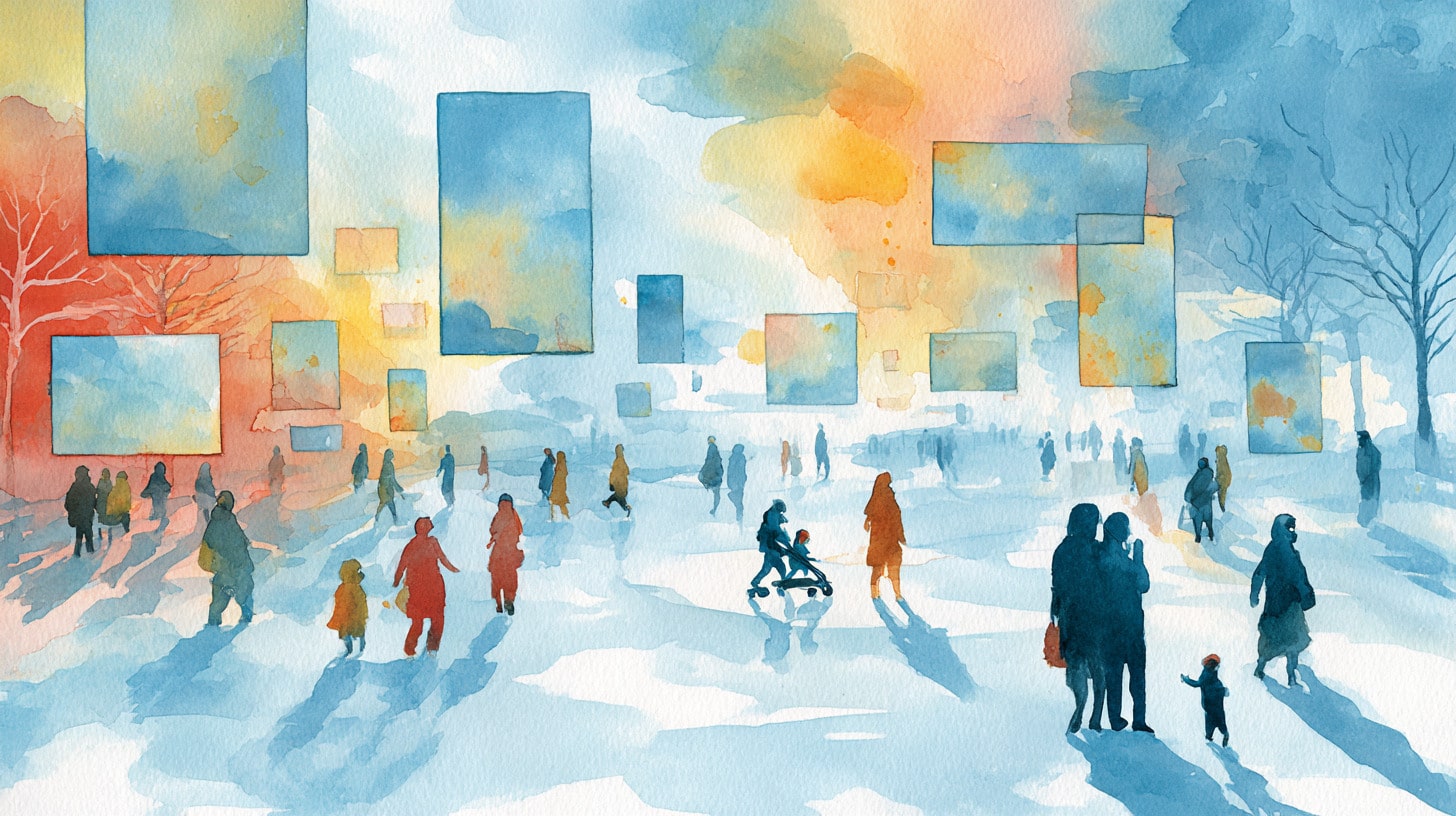
Most of what we know about crime, migration, danger, and safety does not come from what we personally witness. It comes from what we see through screens.

The Feed of Repetition

Clips. Breaking news. Security camera footage. Short videos with bold captions and louder emotions.

A violent incident happens somewhere. It is recorded. It spreads. It is replayed. It shows up again with a different headline. Then again with commentary. Then again as proof of something bigger. For days, sometimes weeks, the same story lives everywhere.

Meanwhile, millions of quiet moments pass without a trace.

  • People wake up.
  • They go to work.
  • They take care of their families.
  • They follow rules.
  • They help strangers.
  • They live ordinary lives.

None of that trends. The mind does not count silence very well.

How the Brain Decides What Is Common

Here is something important to understand about your brain.

It does not measure reality by accuracy. It measures reality by availability.

In simple terms, your brain asks one main question when deciding what feels common: "How easily can I think of an example?"

If an image or story comes to mind quickly, your brain assumes it must happen often. This mental shortcut is called the availability heuristic. It is not a flaw. It is a survival tool.

For most of human history, if something came up often in your mind, it probably meant it was nearby and dangerous. Your brain learned to treat availability as a warning signal.

But the modern world has broken that link.

Now, what is most visible is not what is most frequent. It is what is most shareable.

Why Fear Travels Faster Than Context

Fear moves fast because fear captures attention. A calm statistic does not stop a scroll. A nuanced explanation does not trigger adrenaline. A graph does not compete with a shocking video.

So what spreads is not reality in full. It is reality at its most extreme edges.

The Activation of Existing Stories

When a crime involves an immigrant, it fits neatly into a story many people already carry. It feels explanatory. It feels simple. It feels emotionally complete.

And once that story is activated, every new clip reinforces it.

The brain does not ask, "How often does this happen?" It asks, "Have I seen this before?"

And the answer becomes yes. Again and again.

Over time, exposure turns into belief, because repetition feels like evidence.

The Difference Between Frequency and Exposure

This is where critical thinking quietly enters the room. Critical thinking does not shout. It does not accuse. It does not tell you what to believe.

It asks better questions.

One of the most important questions we can ask today is this:

The Core Question

Am I reacting to frequency or to exposure?

Frequency asks how often something actually happens across a population. Exposure asks how often I personally see it.

Those two numbers used to be closer together. They are now very far apart.

How Algorithms Shape Perception

Algorithms are not designed to reflect reality. They are designed to hold attention. And attention is easiest to hold when emotions are high. Especially fear.

Why Immigration Becomes a Perfect Target

Immigration is complex. It involves borders, culture, economics, identity, and change. Complex topics make the brain uncomfortable. So the mind looks for shortcuts.

If a problem can be attached to a visible group, it feels easier to understand. If danger can be linked to "them" instead of uncertainty, it feels more controllable.

The Economics of Narrative

Media narratives often lean into this instinct. Not always consciously. Not always maliciously. But consistently.

Because stories that divide are easier to tell than systems that explain.

  • A single face is more memorable than a long-term trend.
  • A clip is more powerful than a dataset.
  • A villain is easier than a cause.

So immigration becomes a symbol. A container. A place where fear can sit.

What the Data Quietly Says

Here is where things become uncomfortable in a different way.

When you step away from clips and look at long-term data across many countries, a consistent pattern appears:

Immigrants, on average, are not more likely to commit violent crime than native-born populations. In many places, they are less likely.

What This Does Not Mean

This does not mean crime does not exist. It does not mean harm does not happen. It does not mean people's fears are fake.

It means feelings are responding to visibility, not proportion. And visibility is being actively shaped.

Facts move slowly. Fear moves instantly.

The Cost of Confusing Feeling With Truth

When fear grows faster than facts, something subtle changes inside us.

  • We become less curious.
  • We become more certain.
  • We stop asking questions and start defending positions.
  • Nuance begins to feel like weakness.
  • Doubt begins to feel dangerous.

And once that happens, critical thinking shuts down. A scared brain wants clarity. It wants answers.

This is why emotionally charged narratives are so powerful. They bypass logic.

A Different Way of Engaging

Ministry of Meaning is not interested in telling you what to think. It is interested in helping you notice how you think.

So instead of asking whether immigration is good or bad, safe or dangerous, left or right, try starting here:

  • What am I being shown repeatedly?
  • Who benefits when my fear increases?
  • What information am I not seeing alongside what I am seeing?
  • What would this issue look like if it were explained with patience instead of urgency?

Remember: Critical thinking does not require you to abandon feeling. It requires you to be precise about where feeling comes from.

Holding Fear Without Letting It Lead

Here, the enemy is unexamined fear.

It is possible to care about safety, borders, and social cohesion without surrendering your mind to the loudest story in the room. It is possible to acknowledge uncertainty without turning it into blame. And it is possible to feel something strongly while still asking whether that feeling reflects reality.

That pause matters.

In that pause, exposure loosens its grip. In that pause, meaning has space to return.

The Quiet Responsibility of Attention

Every time we share a clip, react instantly, or accept a headline without context, we train our own perception.

Attention shapes what feels real. The world does not become more dangerous because danger exists. It becomes more dangerous when fear replaces understanding.

Critical thinking is about resisting manipulation without becoming numb. It is about staying human in an environment designed to pull us toward extremes.

A Final Question Worth Sitting With

So when you feel that tightening in your chest, that sense that something is going wrong, pause for a moment. Ask yourself gently:

Is this fear coming from what is happening most often? Or from what is being shown most often?

Because what feels common is not always common.

This is a reminder of how carefully our attention needs to be held. Meaning begins there.

Picks for you

The AI Race Is Not a Technology Race

The AI Race Is Not a Technology Race

The AI race is often framed as a competition of intelligence, models, and algorithms, but this essay argues that it is fundamentally an energy allocation problem hidden beneath a narrative of innovation. AI scales not like software but like heavy industry, consuming vast amounts of electricity and triggering political, social, and infrastructural constraints that code alone cannot solve. The real bottlenecks are not technical breakthroughs, but governance issues such as permitting, grid capacity, public consent, and price stability. In this context, energy geopolitics matter less for directly powering servers and more for creating political slack, cushioning public backlash, and making controversial reallocations of power socially tolerable. The true strategic challenge is not building smarter machines, but justifying why machines should receive scarce energy before people, and doing so without eroding trust or legitimacy. If the AI era succeeds, it will be because societies align energy, politics, and meaning through a story people can live inside; if it fails, it will be because that bargain is rejected.

Read more
2026 and the Return of the Whole Mind

2026 and the Return of the Whole Mind

As we move toward 2026, many of us are sensing a quiet imbalance. We think faster, consume more information, and rely heavily on analysis, yet feel less grounded, less certain, and more disconnected from ourselves. This essay argues that the problem is not thinking itself, but thinking in isolation. For decades, logic, efficiency, and control have been rewarded while intuition, emotion, imagination, and embodied knowing were sidelined. AI now exposes this imbalance by outperforming humans in pure analysis, making it clear that competing on cognition alone is a dead end. What remains distinctly human is the ability to sense context, notice subtle signals, integrate feeling with reason, and act with timing rather than urgency. Burnout, anxiety, and chronic overthinking are framed not as weaknesses but as signals of misalignment, where inner intelligence has been ignored too long. The future will favor integrated minds, people who can think clearly while also listening inwardly, adapting without panic, and making meaning from lived experience. The return of the whole mind is not nostalgia or softness, but a necessary evolution: a widening of intelligence that allows humans to partner with technology without losing themselves.

Read more
Emotion as Navigation

Emotion as Navigation

Emotion as Navigation argues that emotions are not irrational reactions or inner verdicts, but feedback signals that indicate how our current reality relates to an underlying goal. We do not perceive the world neutrally and then feel about it; perception, emotion, and action form a single system oriented toward movement and adjustment. Positive emotions signal alignment, while negative emotions signal friction, misalignment, or outdated assumptions. Problems arise when we treat emotions as authority instead of information, or when the goals guiding our lives remain unexamined. Critical thinking does not suppress emotion, it interprets it by asking what aim the feeling is responding to and whether that aim still deserves commitment. When emotions are read as data rather than commands, they become a navigational compass rather than a source of confusion. A meaningful life, then, is not emotionally smooth but directionally coherent, guided by alignment rather than by the pursuit or avoidance of feelings themselves.

Read more
Thinking Under Pressure in the Age of AI

Thinking Under Pressure in the Age of AI

Thinking Under Pressure in the Age of AI argues that the real risk of AI is not incorrect answers, but how its speed, clarity, and confidence interact with human cognitive biases. Our minds rely on shortcuts designed for efficiency, and AI amplifies these shortcuts by making information feel complete, authoritative, and easy to trust. Biases shape what we notice, how we judge probability, how we commit to decisions, and how emotion quietly leads reasoning, often without awareness. Critical thinking today does not mean rejecting AI or eliminating bias, but slowing down enough to recognize when judgment is being bent by familiarity, confidence, framing, or emotional ease. As AI accelerates information flow, human responsibility shifts toward interpretation, verification, and self-awareness. When we notice our own thinking habits, AI remains a tool; when we do not, it quietly becomes the driver.

Read more
Good, Bad, and the Direction of Attention

Good, Bad, and the Direction of Attention

Good, Bad, and the Direction of Attention argues that we do not experience the world as inherently good or bad, but as helpful or obstructive relative to an often unexamined aim. Our attention, emotions, and moral judgments are shaped by the direction we are moving in, not by neutral facts. What accelerates our path feels “good,” what slows it feels “bad,” even though neither quality exists on its own. This is why people can react morally in opposite ways to the same event, they are oriented toward different goals. The danger arises when the aim itself remains invisible, because alignment then masquerades as virtue and resistance as evil. Critical thinking begins by asking what aim is generating a reaction, not by defending the reaction itself. When we examine direction before judgment, we regain freedom to question whether speed equals progress, whether friction equals harm, and whether what feels urgent actually leads somewhere meaningful.

Read more
What If We Are Living in a Simulation?

What If We Are Living in a Simulation?

What If We Are Living in a Simulation? treats simulation theory not as sci-fi speculation but as a lens for understanding why the world looks the way it does. Simulations exist to explore unknown outcomes, not to preserve harmony, and when viewed this way, suffering, chaos, and instability stop looking like errors and start looking like data. Human history, with its late arrival, layered complexity, religions, governments, markets, and now AI, resembles a staged experiment where new parameters are introduced to increase unpredictability. Meaning, in this frame, does not disappear, it intensifies. If outcomes are uncertain, then choices matter more, not less. Whether the universe is simulated or not, we already live inside conditions where agency, values, and response shape trajectories. We are not spectators waiting for answers, but variables whose actions feed the system itself. The unfinished nature of reality is not proof of meaninglessness, but evidence that participation is the point, and that how we act under uncertainty is the real test.

Read more
Simulation Took Over Reality

Simulation Took Over Reality

Simulation Took Over Reality explores how modern life has quietly shifted from lived experience to representations of experience, a condition Jean Baudrillard called simulation. We no longer relate to reality directly but through signs, images, profiles, brands, and narratives that increasingly reference each other instead of anything real. Photos shape how life should look, information arrives faster than reflection, and meaning collapses under constant immediacy. In this hyperreal world, feeling real replaces being real, performance replaces identity, and symbols become more powerful than substance. Simulation succeeds not because it is false, but because it is optimized for attention, desire, and speed. The essay does not argue for escaping the system, but for awareness within it: noticing moments that do not perform, experiences without an audience, and forms of presence that resist translation into content. The danger is not living inside simulation, but forgetting that we do, and mistaking the copy for life itself.

Read more

Comments

Sign in to join the discussion.
Loading…