
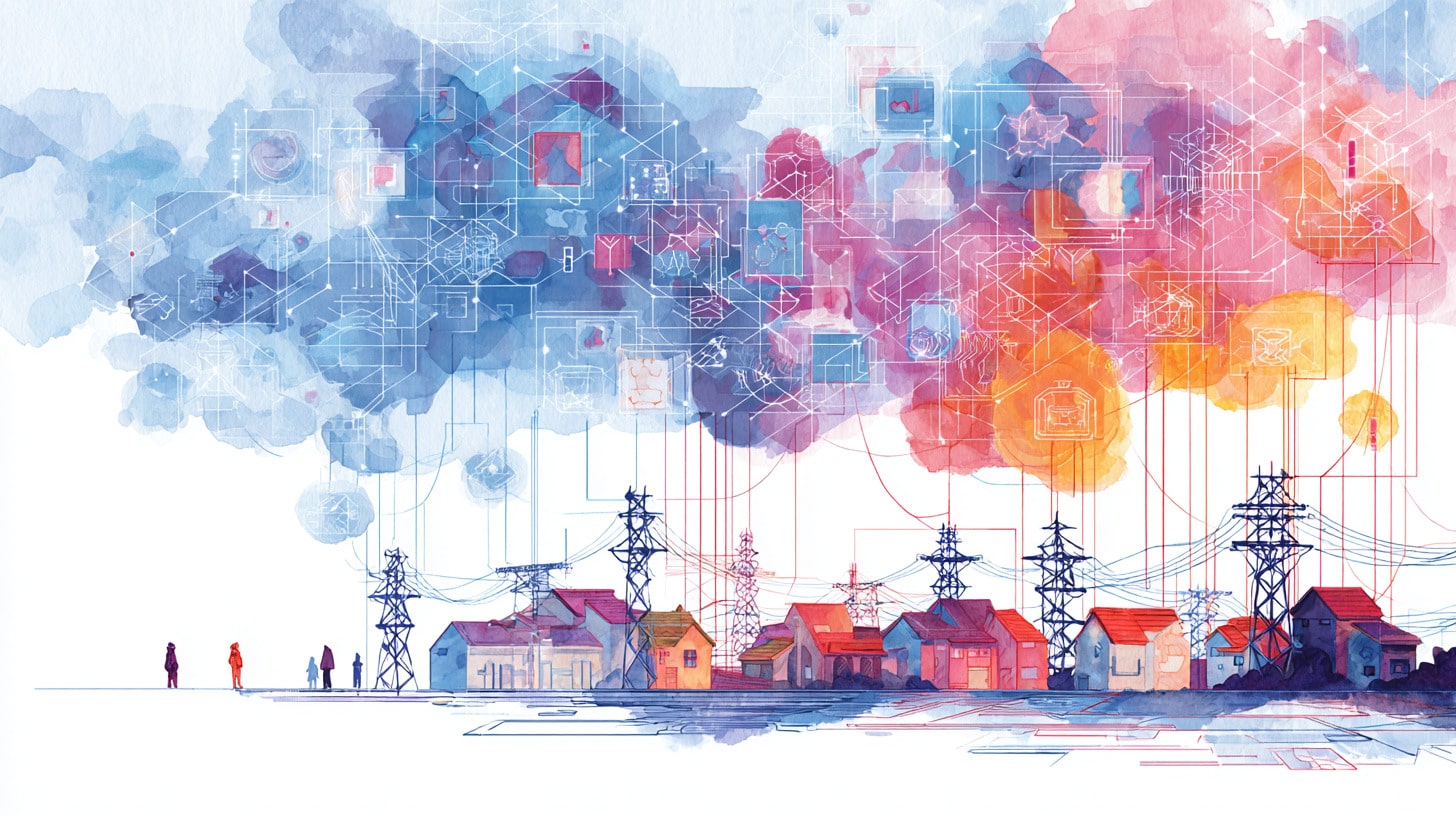

It Is an Energy Allocation Problem Disguised as Innovation
Every era has a story it tells itself.
Ours tells a story about intelligence. We say the future will be decided by algorithms, models, and breakthroughs in reasoning. We talk about GPUs, transformers, benchmarks, and emergent behavior. We imagine a race between labs, nations, and companies. We picture scientists and engineers as the protagonists.
But beneath this story runs a quieter one.
A story about energy.
Not in the abstract sense of sustainability slogans, but in the brutally physical sense of electrons, fuel, heat, grids, and political trade-offs. A story about who gets power, who pays for it, and who decides which uses matter more.
Once you start looking there, the AI race changes shape. It stops looking like a sprint between ideas and starts looking like a negotiation over resources.
Intelligence Eats Power
Artificial intelligence does not scale like software. It scales like industry.
Each new model requires more compute. More compute requires more electricity. More electricity requires power plants, transmission lines, cooling systems, water access, land, permits, and social consent.
This is where the story becomes uncomfortable. Because electricity is not an infinite abstraction. It is a shared resource. When large data centers appear, households notice. Prices shift. Grids strain. Communities push back.
Suddenly, intelligence is no longer just clever code. It becomes a political question.
- Who gets cheap power.
- Who absorbs volatility.
- Who is told to wait.
The Hidden Constraint
For years, the dominant narrative assumed that energy would simply adjust. That markets would respond. That innovation would smooth everything out.
That assumption is failing.
Across advanced economies, the bottlenecks are not fuel scarcity. Oil and gas still exist in abundance. The bottlenecks sit elsewhere.
- Permitting.
- Transmission.
- Local opposition.
- Grid congestion.
- Time.
These are not engineering problems alone. They are governance problems. And governance problems do not yield to faster chips.
A Shift in the Question
This is where speculation begins.
If the real constraint on AI dominance is not intelligence itself, but the ability to allocate energy without political collapse, then the strategic question changes.
The question stops being: "How do we build better models?"
It becomes: "How do we secure political permission to redirect power toward machines without losing social legitimacy?"
Once you ask that question, energy geopolitics re-enters the picture in an unexpected way.
Energy as Political Slack
Energy has always carried more than heat. It carries stability.
Cheap energy buys calm. Stable prices buy patience. External supply buys room to maneuver.
This is not new. Industrial history is full of examples where access to external resources allowed internal transformation.
The difference now lies in the direction of reallocation. In previous eras, energy was diverted toward factories, railways, or housing. Today, it is diverted toward computation.
And computation does not vote. People do.
Which means every megawatt allocated to AI competes with someone's comfort, livelihood, or sense of fairness.
This is where external energy supply becomes strategically interesting. Not because it powers AI directly, but because it cushions the politics around power.
The Buffer Hypothesis
Imagine a state facing rising electricity demand from AI infrastructure.
Households feel price pressure. Industries complain. Local governments resist new transmission lines. Politicians hesitate.
Now imagine that same state has access to additional external energy supply.
Oil or gas imports increase. Global prices soften. Inflation eases. Energy headlines calm down.
Nothing magical happens to the grid. No new electrons appear where data centers sit.
But something subtler happens. Political space opens.
The government can tolerate localized price increases. Utilities can prioritize industrial connections. Regulators can approve controversial projects with less backlash.
In this frame, energy imports function as a buffer. They do not solve the physical constraint. They soften the social one.
This is a second-order effect, but second-order effects often shape outcomes more than first-order logic.
Why This Feels Uncomfortable
This line of thinking makes people uneasy for good reason.
It suggests that the AI race may involve deliberate choices about whose energy security matters more. It suggests that households might be implicitly asked to accept trade-offs so that machines can think faster. It suggests that geopolitical energy moves might have less to do with immediate need and more to do with managing domestic consent.
That is not a story we like to tell ourselves.
We prefer narratives of progress where everyone benefits at once. Reality rarely cooperates.
The Mistake of Literal Thinking
A common error in discussions like this is to think literally.
To imagine oil flowing directly into data centers. To picture AI servers powered by foreign fuel. To assume a simple substitution.
That misses the point.
Energy strategy operates at system level, not appliance level. No serious planner thinks in terms of one barrel equals one server.
They think in terms of price signals, public tolerance, regulatory flexibility, and crisis resilience. They think in terms of options.
Options Matter More Than Plans
In complex systems, control is less valuable than optionality.
Having an additional energy source available matters even if it is not used at full scale. It changes bargaining power. It shifts expectations. It alters what is politically feasible.
From that angle, energy geopolitics and the AI race intersect not through cables, but through confidence.
- Confidence that domestic grids can be leaned on harder.
- Confidence that price spikes can be managed.
- Confidence that public anger can be absorbed.
The Risk of Misreading Power
There is a danger here.
When energy becomes instrumentalized in service of computation, the temptation is to reduce people to variables. Households become demand curves. Communities become obstacles. Opposition becomes noise.
History suggests this path ends poorly.
Societies tolerate reallocation only when they believe it serves a shared future. When the benefits feel abstract or distant, legitimacy erodes.
The AI race, if framed purely as a strategic necessity, risks severing that connection.
Meaning as the Missing Layer
This is where meaning re-enters the conversation.
Technology races succeed when they are embedded in stories people can live inside.
The space race worked not because rockets were efficient, but because the story connected exploration, pride, and collective destiny.
The AI race currently lacks such a story. People hear about models replacing jobs, consuming power, and concentrating wealth. They do not hear a convincing answer to the question: why this trade-off is worth it for them.
Without meaning, energy allocation becomes extraction. With meaning, it becomes contribution.
The Real Strategic Question
So the deepest question is not whether energy geopolitics can support the AI race.
It can.
The question is whether societies can articulate a reason to do so without fracturing themselves.
Can energy be reallocated toward intelligence while preserving dignity, fairness, and trust. Can political leaders explain why machines deserve priority without implying that people matter less. Can the benefits of AI arrive quickly enough to justify the costs people feel now.
These are not technical questions. They are moral and narrative ones.
A Final Speculation
If the AI era fails, it will not fail because models plateau. It will fail because societies refuse the bargain.
If it succeeds, it will not be because of superior algorithms alone. It will be because someone figured out how to align energy, politics, and meaning without tearing the social fabric.
In that sense, the AI race is not about who builds the smartest machines.
It is about who learns to tell the most honest story about power.
Ministry of Meaning Takeaway
Critical thinking does not demand certainty. It demands that we notice what sits underneath our stories.
Right now, beneath the story of intelligence, there hums a grid.
And grids, unlike narratives, do not lie.


