
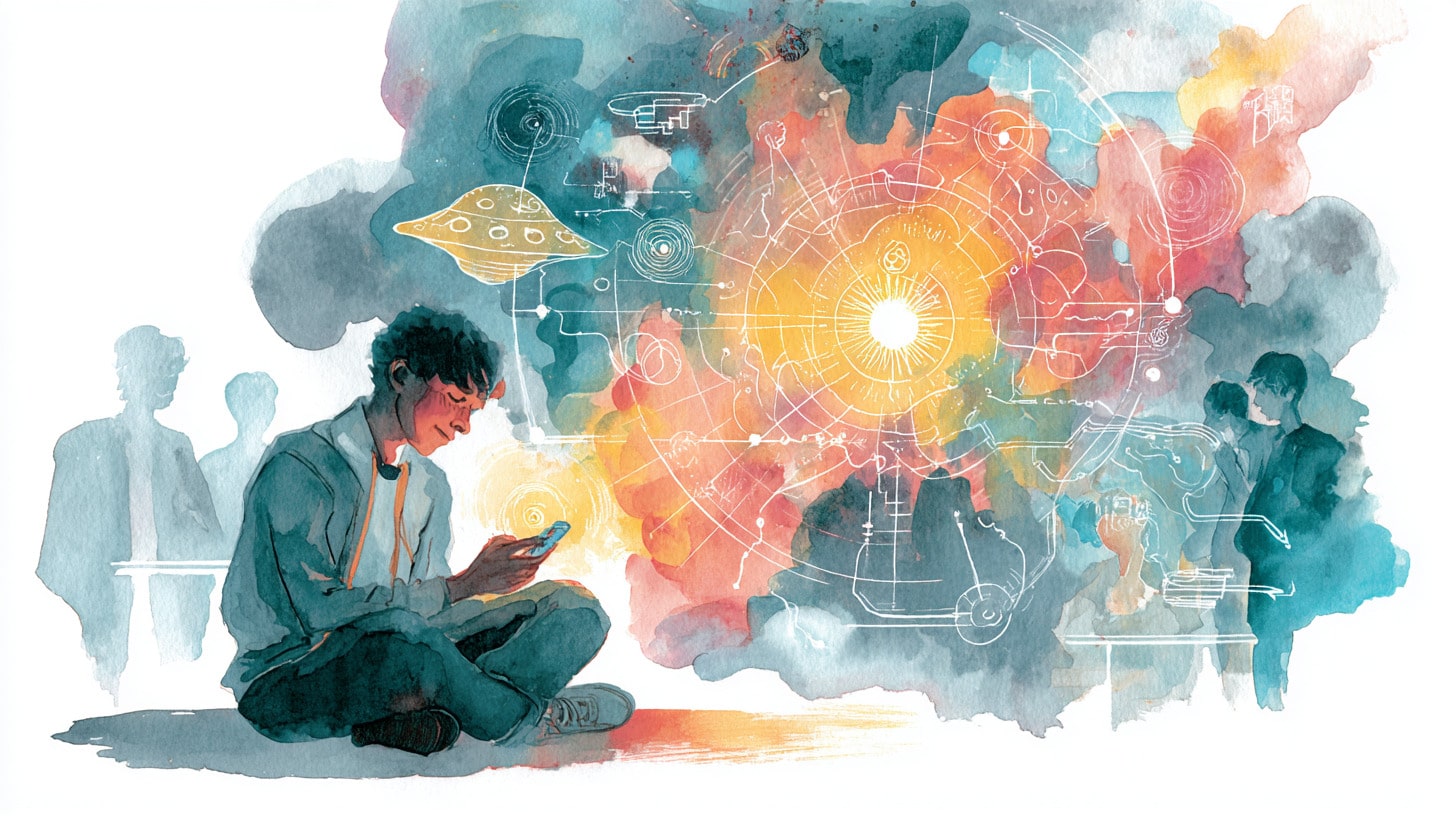

Let’s stop pretending this is complicated. Young men are not suddenly obsessed with UFO whistleblowers, secret government files, “new religions,” cultish self-help prophets, or cosmic conspiracy theories because they woke up one morning craving weirdness. This didn’t happen by accident. This is the result of an attention economy that figured out something dangerous: young men are starving for meaning.
And when a generation feels lost, the people who control the digital megaphones don’t give them purpose. They give them content. Preferably the kind that triggers their fear, their hope, their loneliness, their need to feel chosen, their need to feel right.
That’s why UFO testimony hits the algorithm harder than therapy. That’s why modern “religious influencers” outperform real community leaders. That’s why a video telling young men “it’s not your fault, the system is broken” gets a million views while anything about actual emotional work gets ignored.
The elite attention engineers know exactly what they are doing. They sell you the illusion of meaning, not meaning itself.
Let’s break it down.
The Crisis Nobody Wants to Admit
There is a generation of young men sleepwalking through life. Not because they’re weak. Not because they’re lazy. But because they were raised inside systems that promised opportunity and delivered anxiety, promised connection and delivered loneliness, promised freedom and delivered a never-ending psychological treadmill.
But instead of talking about unspoken grief, social disconnection, and collapsing identities, the algorithm gives them spectacle.
Because spectacle keeps people hooked. Healing does not.
- UFO hearings? Hook.
- Mystical new gurus? Hook.
- Apocalyptic predictions? Hook.
- Podcasters screaming about decline? Hook.
The more anxious young men feel, the easier they are to retain.
And the elite voices who know how to market existential panic have turned it into a business model. Scott Galloway, for example, built an entire empire on telling young men they’re failing because society is broken and they should be angry. Sam Harris built a massive platform on secular spirituality and existential dramatics, feeding the appetite for grand narratives without ever offering grounded solutions.
These men aren’t villains. They’re just playing the game.
But the game itself is the problem.
UFOs: Meaning on Demand
Look at the surge of UFO content over the last three years. Suddenly every algorithm is pushing whistleblowers, Pentagon leaks, alien bodies, secret spacecraft, “non-human biologics,” you name it. It’s everywhere. Why?
Because UFOs offer something irresistible to young men:
- a story where they finally matter.
- If aliens exist, then life has a larger purpose.
- If aliens have visited, then governments are lying.
- If governments are lying, then you’re one of the few who “knows the truth.”
That feeling is addictive.
That feeling sells.
And it’s much easier than dealing with your actual life.
Who needs therapy when the universe might be hiding a galactic conspiracy?
Who needs community when you can join a subreddit with a thousand people who think like you?
Who needs purpose when you can feel like a chosen observer of the greatest secret in human history?
The attention economy knows this.
And it feeds it deliberately.
New Religions: The Algorithm as a Prophet
Religion used to be a stable institution. Slow. Grounded. Heavy.
Now religious meaning is served like fast food.
Bite-sized spirituality.
Mystical aesthetic edits.
Clip-sized enlightenment.
People like to say young men have become “less religious”.
Wrong. They’ve become hyper-religious.
But their religion is algorithmic.
- Their gods are podcasts.
- Their scriptures are viral clips.
- Their prophets are influencers with ring lights.
- Their rituals are doomscrolling.
- Their churches are Discord servers.
Instead of moral teachings, they get “5 signs you’re not the problem, the world is.”
Instead of community, they get a comment section.
Instead of discipline, they get shortcuts to “unlocking your potential.”
Instead of humility, they get the intoxicating sense of being “awake” while everyone else is “asleep.”
This is what the algorithm sells:
- micro-doses of identity.
- micro-doses of meaning.
- micro-doses of belonging.
None of it requires effort.
All of it keeps you scrolling.
And every scroll prints money for someone else.
The Elite Know the Game
Let’s be blunt.
People like Scott Galloway or Sam Harris play this game better than most.
Both of them built massive audiences by tapping into the emotional chaos of young men.
Galloway positions himself as the father figure yelling, “It’s not your fault”, using market data as a moral weapon.
Harris offers existential clarity dressed as rational truth, dripping with enough drama to feel urgent.
These men are extremely smart.
They understand attention.
They understand despair.
They understand the psychological vulnerability of young men better than any government think tank ever has.
But the system around them is the real architect.
The platforms boost the most emotionally charged voices because those voices create engagement.
Not hope.
Not empowerment.
Engagement.
The elite don’t have to manipulate anything.
The algorithm already does it for them.
Why Young Men Are the Target
Young men are easy prey for a simple reason:
They are the demographic with the highest emotional volatility and the lowest support structures.
- They are more likely to be lonely.
- More likely to lack mentors.
- More likely to feel useless.
- More likely to search for meaning online.
- More likely to spiral into identity confusion.
- More likely to consume radicalizing content.
When you combine loneliness with uncertainty and an identity vacuum, you get a perfect storm.
And the platforms know exactly how to harvest it.
So they feed them:
- UFOs to feel special.
- New religions to feel guided.
- Crisis narratives to feel justified.
- Villains to blame so they don’t question deeper truths.
Every video telling young men “you’re not the problem” gets millions of views not because it’s true but because it reinforces emotional dependence.
If the world is the problem, you don’t have to change anything.
You just have to watch more content.
The Attention Economy Needs Young Men to Stay Confused
This is the darkest part of the whole story:
The system does not benefit from young men healing.
Healing makes you stable.
Stable people are boring to the algorithm.
Boring people don’t click.
A healed young man doesn’t watch 30 UFO videos in a row.
A grounded young man doesn’t follow a self-proclaimed prophet on TikTok.
A confident young man doesn’t need someone shouting “you’re not broken” every day.
If young men became emotionally healthy, half the attention economy would collapse overnight.
So the system keeps them hooked by keeping them uncentered.
It keeps them entertained by keeping them confused.
It keeps them scrolling by keeping them unsure of themselves.
This is not an accident.
It’s a strategy.
Meaning Has Become a Product
It’s easy to believe we’re living in a moment of spiritual awakening or cosmic revelation.
The truth is harsher:
We’re living in a moment of engineered meaning.
UFOs aren’t a movement.
They’re a product.
New religions aren’t a revival.
They’re a business category.
The crisis of young men isn’t a tragedy.
It’s a market.
The attention economy is not evil.
It is efficient.
And efficiency means giving young men the exact emotional content that keeps them most dependent.
- Fear.
- Wonder.
- Anger.
- Loneliness.
- Cosmic curiosity.
- Existential dread.
Everything except real connection.
Everything except real mentorship.
Everything except real community.
Everything except real purpose.
What’s Really at Stake
When young men spend enough time inside these algorithmic worlds, something shifts.
Not quickly.
Quietly.
Their imagination changes.
Their worldview shifts.
Their sense of identity erodes.
Their emotional baseline collapses.
And then they start thinking the world is ending.
They start believing secret forces control everything.
They start thinking their lives are meaningless unless they fight some invisible enemy.
They start confusing content with truth.
This is not entertainment.
This is psychological colonization.
If a generation of young men grows up believing that aliens, cosmic revelations, and new religions are going to save them from a world that feels heavy and directionless, then we’re not dealing with a cultural phase.
We’re dealing with a slow, quiet collapse of meaning.
So Where Do We Go From Here?
Here’s the honest answer:
Young men don’t need more UFO videos.
They don’t need another distorted religion.
They don’t need more doomsday narratives.
They don’t need more gurus.
They need a foundation.
A community.
A challenge that demands real effort.
A mission that’s grounded in reality.
A space where they can talk, be vulnerable, and not feel judged.
The platforms won’t give them that.
There is no profit in grounded masculinity.
There is no profit in genuine meaning.
There is no profit in stable, mentally healthy young men.
But there is power in reclaiming your attention.
And there is liberation in refusing to be emotionally manipulated by systems that want you to feel broken.
Young men don’t need the algorithm to tell them who they are.
They need to become the authors of their own meaning.
Everything else is noise.


