
1. The uncomfortable question Nexus put in my head
After reading Nexus, one question stayed with me and kept echoing in the background of my days:
If humans are so clever, why do we keep driving ourselves toward disaster?
We can send rockets into space, decode DNA, and design models like AI. At the same time, we damage our own planet, flirt with war, and build tools that might harm us.
For a long time I thought the answer was simple. Maybe humans are just selfish or broken by nature. Nexus offered a different view that felt both scary and strangely hopeful:
The main problem is not who we are.
The main problem is what we believe.
Give basically decent people bad information, and they will still make terrible decisions.
That idea was the thread of the whole book for me. Once I pulled on it, everything else started to make sense.
2. Facts do not move people, stories do
One of the big things I learned is how weak facts are on their own.
You can know the physics of how a rocket works and still never build one. To launch a rocket, run a hospital, or create a social movement, millions of people have to cooperate.
- Facts explain how things work.
- Stories explain why we should care.
Behind every huge project there is a story that gives people a reason to wake up, show up, and keep going, even when the work is boring or hard.
Think of something modern, like creating a new vaccine. You need:
- Scientists in labs
- Engineers building machines
- Nurses and doctors giving doses
- Drivers moving supplies
- Farmers growing food so everyone can eat while they work
Telling all these people “Here are the facts about proteins and viruses” is not enough. Facts will not make thousands of people move in one direction.
What actually moves them is a story.
A story about saving lives, protecting families, defending the country, or growing the economy.
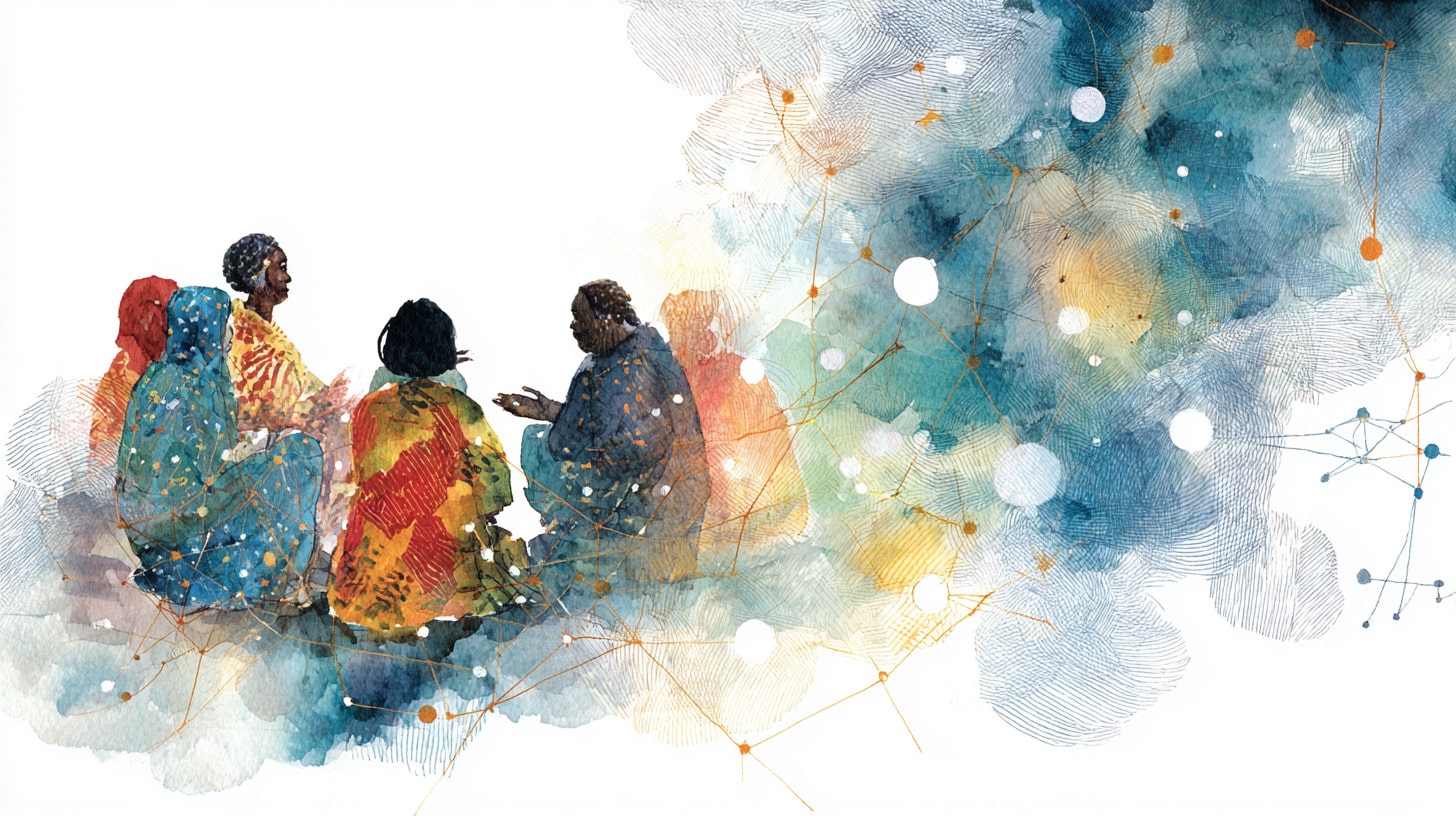
Nexus helped me see that our world is built from these invisible stories:
- Countries are stories we agreed to believe.
- Money is a story we agreed to believe.
- Companies and brands are stories we agreed to believe.
These stories are powerful. They coordinate millions of strangers without any of them ever meeting in person.
So the real power in the world is not held by the people who only know the facts. It is held by the people who shape the stories.
That connects deeply to storytelling as one of the core human skills I care about. Stories are not decoration. They are infrastructure.
3. The new storyteller in the room: a non-human mind
For most of human history, only humans could invent stories. Every song, every holy book, every ideology, every economic theory came from a human brain.
Now something new is in the room with us.
AI can write poems, generate images, compose music, suggest strategies, and invent new “games” for us to play. It is starting to create many of the cultural objects we live inside.
That was one of the most unsettling insights from Nexus for me. We are slowly moving from:
“Humans live inside human made stories”
to
“Humans live inside stories written partly by non human minds”
AI does not get tired. It does not sleep. It can explore patterns and strategies in ways we cannot even imagine, like AlphaGo did in the game of Go. It discovered winning moves that humans did not consider for thousands of years.
This is exciting and frightening at the same time:
- Exciting, because AI can reveal new ideas, tools, and solutions.
- Frightening, because we do not fully understand how it thinks or on which “stories” it will train our minds.
Nexus helped me drop the illusion that AI is just a neutral tool. The more it generates texts, images, and decisions, the more it becomes a shaper of culture.
In other words, a storyteller.
4. How new information tools quietly reshape power
Another key lesson from the book is that new information technology always reshapes society, even when the tech looks simple.
Writing started with something as basic as marks on clay. That shift allowed kings and officials to store records, track land, and collect taxes. Suddenly a distant ruler could know who owned which field. That changed ownership, power and control.
The pattern repeats:
- Writing enabled kingdoms and empires.
- Mass media, like radio and television, enabled both modern democracies and totalitarian regimes.
- Now AI and digital networks are enabling something even more radical.
Earlier information systems were limited by human bodies and brains. People needed to sleep, rest, and take days off. Even in the most controlling regimes, there were always gaps where no one was watching you.
Modern AI systems do not need rest. They can watch, analyse and decide around the clock. They can process more information than any human could handle.
That leads to a few important risks:
- Less privacy, because more of our daily life can be tracked, stored and analysed.
- Less “off time”, because markets, news and platforms run twenty four hours a day.
- Less understanding of decisions, because opaque algorithms may decide who gets a loan, a job, or medical treatment.
What hit me is how this changes the feeling of life. You can start to feel like you are always in a job interview, always being evaluated by systems you do not see and cannot fully question.
As an organic, tired, emotional human, that is exhausting.
5. Information is cheap, truth is expensive
Another big insight from Nexus is the difference between “information” and “truth”.
We often treat them as the same thing. They are not.
Most information in the world is not true. It is:
- Opinion
- Propaganda
- Fantasy
- Guesswork
- Manipulation
Creating noise is very easy. You can draw a face of a historical figure without any research. You can write a story about an event without checking any facts.
Creating truth is hard and expensive. It needs:
- Time
- Evidence
- Verification
- People who are trained and paid to check things
When the world gets flooded with information, the truth does not rise to the top by itself. It can actually sink and disappear underwater.
This part of the book connected strongly with what I already feel about attention and critical thinking in the age of AI. Our minds are surrounded by feeds and headlines that compete for emotional reaction, not for accuracy.
So the question becomes:
How do I protect my mind in a world where stories are cheap and truth is rare?
Nexus suggests that we need strong, living institutions that are able to correct themselves, like good science, solid journalism, and healthy democracy. These systems are not perfect, but they build in ways to admit mistakes and change course.
Without such self correcting systems, powerful AI in the hands of total control can become extremely dangerous.
6. What Nexus changed in how I want to live
Reading Nexus did not give me a simple answer or a clear prediction of the future. Instead, it changed how I want to behave in the present.
Here are a few personal shifts I took from the book.
6.1. Be more careful with the stories I swallow
I want to slow down and ask:
- Who is telling this story?
- What do they gain if I believe it?
- Does it help me care about real humans or only about an abstract tribe?
This is where critical thinking meets storytelling. The goal is not to reject all stories. The goal is to see them clearly, instead of being unconsciously ruled by them.
6.2. Protect human conversation
Democracy is basically a large, messy conversation. If that conversation is filled with bots, fake people, and persuasive algorithms pretending to be humans, trust collapses.
One simple rule I like from Nexus is this: if an AI is talking, it should say that it is an AI. If we cannot tell who is human and who is not, honest dialogue becomes almost impossible.
So in my own life, I want to value spaces where actual people speak as themselves. Slower, less polished, but real.
6.3. Take an “information diet” seriously
Just like food, not all information is healthy. Constant input of fear, outrage and gossip will shape my inner world.
So I want to:
- Have regular breaks from feeds and news
- Choose a few trusted sources instead of endless random links
- Give my mind time to digest instead of always adding more
In a way, this is also about imagination and empathy. When the mind is not flooded, there is space to feel, to imagine, and to care again.
6.4. Stay human in an AI age
Finally, Nexus reminded me of the skills that remain deeply human:
- The ability to question and reflect
- The ability to feel with others without losing myself
- The ability to tell and reshape stories
- The ability to imagine different futures
AI can help with all of these, but it does not replace them. It reflects the consciousness of whoever uses it.
So my main takeaway is simple:
If I want a wise future with AI, I have to become a wiser human now.
I have to choose my stories more carefully, guard the quality of my information, and practice the soft skills that make us human in the first place.
Nexus did not answer the question “Will we destroy ourselves or not”. No book can do that.
What it gave me is something more practical:
A clearer view of the invisible forces shaping my mind, and a deeper responsibility for the stories I choose to believe, spread, and live by.


