
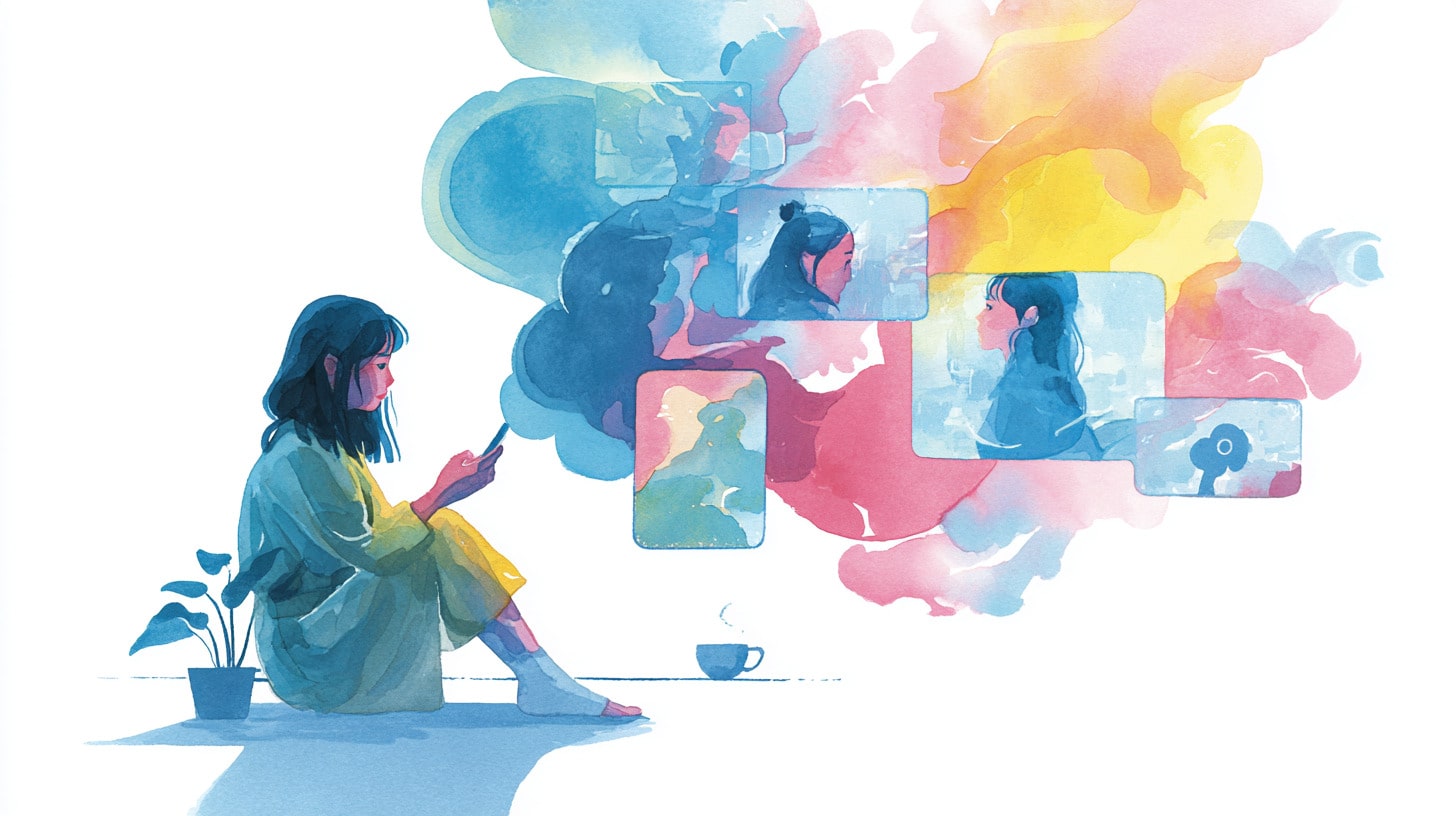

We open Instagram for one thing. A quick check. A message, a story, a notification.
And then it does that classic trick. Ten minutes disappear. We close the app and we are not even sure what we saw. Just a blur of faces, bodies, opinions, jokes, “perfect” breakfasts, and tiny performances. Some of it is genuinely good. Some of it is weirdly heavy. Most of it is forgettable.
That mix is the point.
We are living in the social media era. Instagram is not just “an app” anymore. For a lot of us, it sits inside identity. It is where our friends exist publicly. Where our work gets seen. Where our taste, our humor, our values, our photos, our “this is me” live. Deleting it can feel like deleting a part of our social map.
So we can keep Instagram and still be honest about its pressure points. We can enjoy it and also name what it quietly does to us.
Before Instagram, our audience was small on purpose
Think about social life before the feed.
Most of us had a handful of communities. Family, neighbors, classmates, coworkers, a local hobby group. We were not constantly visible to hundreds or thousands. We did not try to be interesting to a mass of semi strangers. We mostly lived inside a smaller circle of people who had context for us.
That mattered.
Because the old setup had friction, but it also had safety. Our reputation was local. Our awkward phase was not searchable. Our jokes did not need to travel. And our “image” was not something we maintained daily. It formed slowly, through repeated real moments.
Instagram flips that. It turns everyday life into something we can broadcast. And it adds two ingredients that change human behavior fast: visuals and metrics.
Marshall McLuhan put it simply: “The medium is the message.” Even when we think we are just consuming content, the format still shapes us.
The quiet psychological costs we keep bumping into
Comparison becomes the default setting. Instagram is built for upward comparison because it is a highlight machine. Even when we know it is curated, our nervous system still reacts. We can feel behind, less attractive, less successful, less interesting, without any single dramatic moment. It is just a drip.
Our self worth can start negotiating with numbers. Likes, views, follower counts, saves. Tiny numbers, but also tiny social signals. We can catch ourselves checking, tweaking, posting, deleting, reposting. Over time, motivation can slide from “we like this” to “will this land?” We do not need a clinical label for it to feel real.
Body image pressure is not subtle on a visual platform. When a platform is image first, it is also appearance first. Filters, angles, lighting, edits. Even when we do not believe the illusion, we can still absorb the standard. And some of us are more vulnerable to that than others, especially around eating and self perception.
Attention gets chopped into feed shaped pieces. The design rewards rapid switching and constant novelty. We can feel it in our bodies. Restlessness. The itch to check. The sense that quiet is a little harder to sit with. Even when we enjoy the content, time can feel slippery.
Relationships can look more connected and feel less intimate. We can keep up with many people while talking to almost nobody. We can feel socially full while emotionally underfed. Sherry Turkle has a line that keeps coming back for a reason: “We expect more from technology and less from each other.”
None of this makes Instagram “bad.” It just means the platform has predictable pressure points, and we are human, so we respond predictably.
The philosophical angle: who is steering the story of our life?
This is where storytelling shows up.
Joan Didion wrote, “We tell ourselves stories in order to live.” Instagram is a story machine. It nudges us into being a narrator and an editor, all the time.
And it rewards a specific style of story. Quick clarity. Instant emotion. A clean arc. A vibe that lands in one second.
That can be fun and creative. It can also flatten real life.
Real life is messy. Growth is boring. Love is repetitive. Healing is slow. Most meaningful things look unimpressive on camera. When the dominant storytelling format becomes “postable moments,” it is easy for us to start feeling like our private, unposted life is somehow less real.
A subtle shift can happen too. We are not only living, we are watching ourselves living. We become our own audience.
That is not a personal failure. It is an environment with incentives.
Critical thinking: what question is the feed answering for us?
Critical thinking is not only about logic. It is also about noticing what shapes attention.
Instagram answers a question all day long, whether we ask it or not: what should we look at next?
That is a powerful role. It can blur our ability to choose our own question, which is the root of thinking.
Carl Sagan’s line fits here: “Extraordinary claims require extraordinary evidence.” On Instagram, “claims” are not only words. They are lifestyle claims, beauty claims, success claims, “my life is the blueprint” claims. The platform can make weak evidence feel strong because the presentation is strong.
A pretty reel is not an argument. A confident caption is not proof. A viral clip is not reality. Those are format advantages.
If we ever want a simple critical thinking posture on Instagram, it often starts with tiny questions we can hold quietly:
- What is this trying to make us feel?
- What is it trying to sell, even if it is selling a worldview?
- What is missing from this story?
- What would we need to know for this to be true?
Empathy: people turn into content faster than we think
Empathy needs attention. Not scroll attention, real attention.
Simone Weil wrote: “Attention is the rarest and purest form of generosity.”
Instagram makes attention scarce by design. It is optimized for movement. Swipe, tap, swipe, tap. Even when we care about someone, we might only have enough attention for a reaction emoji and a quick “love this.”
So a weird thing can happen. We can see more human lives than any generation before us, and still feel less emotionally close to the people right in front of us. Or less patient. Or more easily irritated. Or more judgmental, because we get trained into snap interpretations.
When people are presented as content, it becomes easier for us to forget they have context, pain, contradictions, and full inner lives. That is a quiet empathy leak.
If we had to name one core drawback
If we had to compress it into one sentence, it might be this:
Instagram can slowly push us toward living as a public object, instead of living as a private person who shares sometimes.
That shift touches everything. Self esteem, relationships, attention, body image, values, even what we think life is “supposed” to look like.
And it does not have to be doom. It can just be clarity. We can keep the app, keep the art, keep the connections, and still notice the tradeoffs.


