
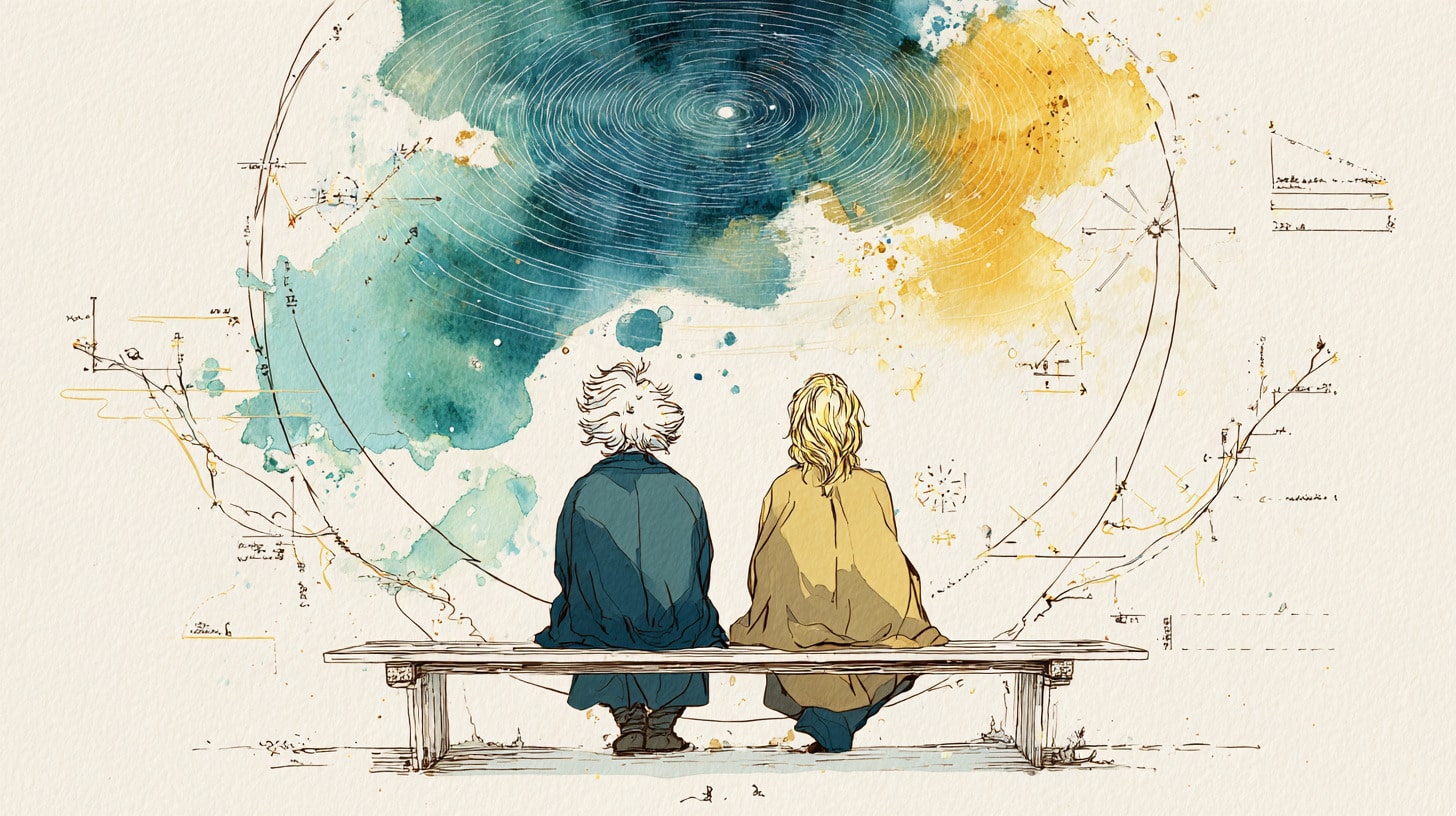

In 1929, a New York rabbi sent a short telegram to Albert Einstein. A Catholic cardinal had just accused Einstein of leading people toward atheism, so the rabbi wanted to hear it from Einstein himself.
“Do you believe in God?” he asked.
Einstein did not send a long essay. He replied with one famous line:
“I believe in Spinoza’s God, who reveals himself in the lawful harmony of the world,
not in a God who concerns himself with the fates and actions of human beings.”
In German, he said:
Ich glaube an Spinozas Gott, der sich in der gesetzmäßigen Harmonie des Seienden offenbart,
nicht an einen Gott, der sich mit Schicksalen und Handlungen der Menschen abgibt.
Einstein was a physicist, not a priest. When he said “Spinoza’s God”, he pointed to a very special way of thinking about God, built by the philosopher Baruch Spinoza in the 17th century.
This article is about that way of thinking.
You do not need a background in philosophy. You also do not need to agree with Spinoza. What matters here is how he reasons, step by step, and how that kind of reasoning can train our own critical thinking.
Philosophy as a practice, not a rule book
Many people think philosophy tries to give final answers: what to believe, how to live, who is right.
There is another way to look at it.
You can read philosophy as a record of how great thinkers used their minds. You watch how they define words. You watch how they move from one idea to the next. You see how they try to avoid contradictions.
In this article, Spinoza is not our “guru”. He is more like a chess master. We are not here to worship every move. We are here to see how he plays.
This is a practice of critical thinking:
- We slow down.
- We follow the logic.
- We ask “If this is true, what follows?”
- We notice where it clashes with other beliefs, like the God of Abrahamic religions.
You can fully disagree with his picture of God and still learn a lot from the way he builds it.
First, the usual picture of God
In Jewish, Christian, and Muslim traditions, God is often seen like this:
- A personal being
- Outside and above the world
- Creator of the universe from nothing
- With will, desire, and choice
- Who can answer prayers, do miracles, forgive, punish, and reward
- Separate from nature, but able to intervene in it
This is a personal God. You can pray to this God. This God can be pleased or angry. God is not the world. God is the creator of the world.
Spinoza did not accept this image. He thought this picture shrinks God to something like a super human: bigger and stronger, but still a kind of person.
So he started somewhere else.
Spinoza’s God in very simple words
Spinoza gives a famous definition in Latin:
Per Deum intelligo ens absolute infinitum.
“By God I understand a being absolutely infinite.”
Let us unpack what this means in plain language.
1. God as the one infinite substance
Spinoza says there is only one basic “something” that truly exists in itself. He calls it “substance”. Everything else depends on this substance.
For him, that one substance is God.
- God is absolutely infinite.
- Nothing can exist outside God.
- Nothing can limit God.
- God does not depend on anything else to exist.
So God is not a person floating above the universe. God is the deepest level of reality itself.
2. God exists by necessity, not by choice
Spinoza also wants to show that this God cannot fail to exist.
He asks: in general, why might something not exist?
He offers three simple options:
- There is no cause or reason for it.
- There is some outside obstacle that blocks it.
- The thing itself is impossible, like a “square circle”.
Now he applies this to God.
-
Option 1: No cause.
Spinoza says God is infinite, so nothing can be outside God to cause him. God must be the cause of himself. So lack of an outside cause cannot explain God’s non-existence. -
Option 2: Outside obstacle.
If God is absolutely infinite, there is nothing outside God. So nothing external can block God. -
Option 3: Inner impossibility.
If God were impossible inside, it would mean there is some limit or contradiction in God’s nature. A limit would mean God is not absolutely infinite.
For Spinoza, none of the three options explain “God does not exist”. That means God’s non-existence is impossible. So God must exist by the very nature of what God is.
In his style, he writes like a geometry book, not like a sermon. He treats “God exists” as a logical result of definitions and steps.
3. God has no parts
Spinoza also says God cannot be made of pieces.
Anything that has parts is limited. One part is here, another is there. Each part has a border. So the whole thing is bounded.
An absolutely infinite being cannot be bounded.
So God must be one and simple, without pieces. Spinoza sometimes calls this substantia una et unica which means “one single substance”.
4. “Deus sive Natura” – God or Nature
Now comes his bold move.
Spinoza says in Latin:
Deus sive Natura.
“God, or in other words, Nature.”
Why does he say God and nature are the same reality?
He reasons like this:
- If God is absolutely infinite, nothing can be outside God.
- Nature exists.
- So nature cannot be outside God.
Then we have two options:
- Nature is only a part of God.
- Nature is God.
But God has no parts. So nature cannot be just a piece. The only option left is that God and nature are one and the same reality, seen in two ways.
So when Spinoza says “God”, he does not mean a person. He means the whole of reality, the one infinite substance, expressing itself in many forms.
He sometimes explains this with images similar to these:
- Imagine the ocean as the one substance.
- Each wave is a “mode” or expression of the ocean.
- Waves appear and disappear, but the ocean remains.
In the same way, for Spinoza, your body, your mind, stars, and trees are modes or expressions of that one infinite reality.
5. No “before” and “after” creation
In this view, creation is not an event where God, sitting alone, suddenly decides to make a world.
If God and nature are one, there is no time when God exists without nature. The substance and its expressions go together.
Also, if God is absolutely complete, God cannot gain something by creating. A decision usually comes from a lack, a wish, or a need. Spinoza thinks an infinite being cannot have such needs.
So he sees the universe as a necessary expression of God’s nature, not as a free project of a personal creator.
He also thinks everything follows the laws of nature with full necessity. There are no miracles that break those laws, no special exceptions. What people call “miracle” is just something they do not yet understand.
Where Spinoza clashes with Abrahamic faiths
Now you can see why Spinoza’s view caused such anger among Jewish, Christian, and Muslim thinkers of his time.
For them:
- God is a person, with will, love, anger, and mercy.
- God is separate from the world and freely creates it.
- God can choose, decide, change plans, and answer prayers.
- God can act in history, send prophets, give laws, and judge souls.
For Spinoza:
- God is not a person.
- God has no will like ours and no changing moods.
- God does not sit outside the world, God is the world at its deepest level.
- There is no plan in the human sense, only necessary order.
- Prayer does not change God or nature. At best, it changes us.
So Spinoza’s God cannot be the God of Abraham, Isaac, Jacob, Jesus, or Muhammad in the usual sense.
Einstein’s line looks clearer now. When he says he believes in “Spinoza’s God who reveals himself in the lawful harmony of the world”, he means he finds something sacred in the order of nature. He does not believe in a personal, watching, judging God that cares about each individual act and each sin.
What this has to do with critical thinking
You might love Spinoza’s idea. You might dislike it. That is not the main point here.
The deeper lesson is in how he thinks.
Spinoza:
- Starts with clear definitions.
- Follows the logic, even when it goes against tradition.
- Checks possible options and rules them out one by one.
- Refuses to adjust his reasoning just to protect a popular belief.
This is critical thinking in action.
You can use a similar approach in your own life, even for non-philosophical questions.
What we can learn from Spinoza’s reasoning
Here are a few simple habits we can borrow from him:
-
Define your words.
Before you argue about “success”, “freedom”, or even “God”, ask: “What do I mean by this word?”
Spinoza begins with Per Deum intelligo… He tells you exactly what he means. -
List the options.
When you face a claim, ask: “In how many ways could this be false or true?”
Spinoza asks: “In how many ways can something fail to exist?” He finds three options, then tests each one. -
Follow the implications.
Ask: “If my definition is right, what must follow?”
Spinoza says that if God is absolutely infinite, nothing can be outside God. From this, he later reaches Deus sive Natura. -
Look for hidden limits.
When you call something “infinite” or “perfect”, check carefully. Are you secretly adding limits?
Spinoza notices that a God who changes mind, feels anger, or needs worship is not really infinite in the way he defines. -
Separate logic from comfort.
An idea can feel safe and familiar, like the image of a personal God. Another idea can feel cold or strange. Critical thinking asks: “What follows from the reasons, not from my feelings?”
Spinoza had a small word engraved on his ring: Caute which means “Carefully”. It is a nice reminder. Think carefully. Move slowly. Check each step.
One last thought
You do not have to become a Spinozist. You do not have to agree with Einstein.
But you can let their way of thinking sharpen your own mind.
When you read philosophy as a record of careful reasoning, not as a set of commands, you train your inner logic muscle. You learn to see how ideas are built, how they support each other, and where they collapse.
Spinoza’s God might stay just an idea for you. Or it might deeply change how you see the world. In both cases, the practice of walking through his arguments can make you a more awake, more patient, more independent thinker.
And that is the real gift here.


