

Skip to content
Blogcritical thinking
Data Sufficiency in the Age of Noise cover
9
Reza Zad's avatarReza Zad

Listen: Data Sufficiency in the Age of Noise

0:000:00

Data Sufficiency in the Age of Noise

1. What GMAT Taught Me About Information

Years ago, when I was preparing for the GMAT, there was one section that shaped the way I think even today. It was called Data Sufficiency. The task was simple. You were given a question and two pieces of information. Your job was not to solve the problem. Your job was to decide if the information was enough. This idea felt new to me. I always believed that solving a problem meant collecting as much information as possible. Data Sufficiency showed me something different. You do not need everything. You only need what truly helps you decide. Here is an example similar to one from the real exam:

Question: What is the value of x?
Statement 1: 3x + 5 = 17
Statement 2: x is an integer

Statement 1 alone gives the answer. Statement 2 does not help. So the first statement is sufficient by itself. Learning this changed something in my mind. I understood that human thinking has limits. Not limits of ability, but limits of attention and clarity. To think well, I needed to know what information matters and what information does not. This lesson felt small back then. Today it feels essential.

2. Living Inside a Flood of Information

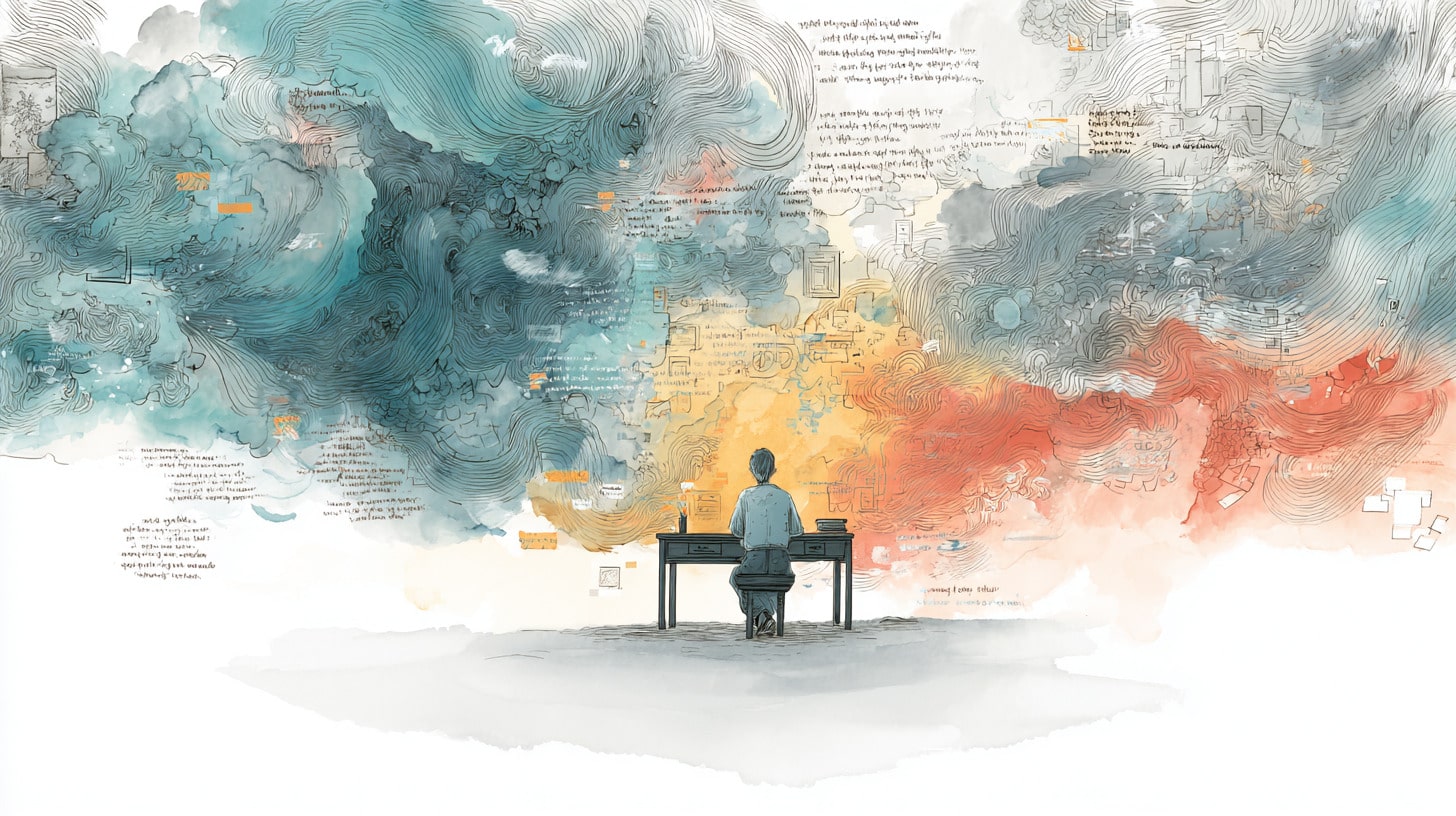
We now live in a world where information never stops. With the internet, fast networks, social media, constant updates, and endless feeds, we feel like everyone has equal access to knowledge. It seems fair. It seems open. But this is misleading. Most of what reaches us is not real knowledge. It is noise. It is entertainment, distraction, outrage, fear, opinion, and algorithm-driven content designed to keep us scrolling. Real information is harder to find because it does not compete loudly for our attention. Real knowledge does not arrive on its own. We must find it, and we must do it actively.

3. How We Slowly Lose Our Awareness

If the purpose of life is to stay aware of the world and aware of ourselves, then we must protect that awareness. We face misinformation from all sides. Social media confuses us. Media corporations shape narratives. Governments push propaganda. All of them, in different ways, guide what we see. Many thinkers warned us long before today. Freud worried that our hidden instincts could guide our decisions without us noticing. Nietzsche looked at how power can twist our sense of truth. Marx studied how economic systems change the way people view reality. They spoke about different forces, yet their message felt similar. Humans can get lost inside systems they do not see. Now we face a new force.

4. The New World Built by AI

Artificial intelligence does more than show us information. It creates content by itself. It writes, draws, speaks, imagines, and builds experiences that look real. It can generate a world, and inside that world create more worlds. This creates a new kind of disconnection. People can spend hours inside a digital environment that learns from them and adjusts to them. The line between truth and creation becomes softer. The separation from reality grows. And this is not happening only through AI. We see it in our own creativity too. There are almost fifty million games inside Roblox. Each one is a small universe. Children spend their days inside these worlds. It shows our creativity, but it also shows our escape. Optimism is beautiful. Blind optimism is dangerous. Technology can help us, but it can also mislead us when we stop questioning. This is where Data Sufficiency returns as a life skill, not an exam skill.

5. Learning to Say “This Is Enough”

The world will keep giving us more information than we can ever process. So the question changes. What is enough for a clear decision?
What is enough for a grounded view?
What information should we ignore? Access to the internet is already global. But this does not mean knowledge is global. We now need societies that know how to think, not just how to connect. We need digital education that teaches children and adults how to check facts, how to identify bias, how to slow down, and how to choose carefully. Clarity is becoming a survival skill.

6. Where This Could Take Us

Here are a few ways the world might evolve:

  • Scenario One: Separate Realities
    People may live in different information bubbles. They may look at the same event and believe completely different things. Shared understanding becomes difficult.

  • Scenario Two: Digital Elders
    A new role may appear. People whose value comes from calm thinking. People who guide others through confusion. Not influencers, but steady voices.

  • Scenario Three: The Return of Slow Learning
    People may turn away from the fast flow of content. They may return to books, long talks, deep study, and thinking in silence.

  • Scenario Four: Conscious Use of AI
    Some will learn to use AI wisely. Not as a replacement for thinking, but as a partner for clearer thinking.

  • Scenario Five: A New Literacy
    Children may learn how to read reality. Not just letters. Not just numbers. But incentives, triggers, patterns, and the small signs of manipulation.

All these futures depend on one ability: knowing how to choose what information matters.

7. The Quiet Power of Clear Thinking

In the GMAT, Data Sufficiency teaches you to decide what information is enough. Today, the same lesson applies to life. We do not need more data. We need the right data. We need clarity. We need agency. We need the courage to filter. The future belongs to the people who can look at the noise around them and say, with steady confidence: “I have enough information to think clearly.” Because in this age, clarity is the new form of intelligence.

Picks for you

The AI Race Is Not a Technology Race

The AI Race Is Not a Technology Race

The AI race is often framed as a competition of intelligence, models, and algorithms, but this essay argues that it is fundamentally an energy allocation problem hidden beneath a narrative of innovation. AI scales not like software but like heavy industry, consuming vast amounts of electricity and triggering political, social, and infrastructural constraints that code alone cannot solve. The real bottlenecks are not technical breakthroughs, but governance issues such as permitting, grid capacity, public consent, and price stability. In this context, energy geopolitics matter less for directly powering servers and more for creating political slack, cushioning public backlash, and making controversial reallocations of power socially tolerable. The true strategic challenge is not building smarter machines, but justifying why machines should receive scarce energy before people, and doing so without eroding trust or legitimacy. If the AI era succeeds, it will be because societies align energy, politics, and meaning through a story people can live inside; if it fails, it will be because that bargain is rejected.

Read more
2026 and the Return of the Whole Mind

2026 and the Return of the Whole Mind

As we move toward 2026, many of us are sensing a quiet imbalance. We think faster, consume more information, and rely heavily on analysis, yet feel less grounded, less certain, and more disconnected from ourselves. This essay argues that the problem is not thinking itself, but thinking in isolation. For decades, logic, efficiency, and control have been rewarded while intuition, emotion, imagination, and embodied knowing were sidelined. AI now exposes this imbalance by outperforming humans in pure analysis, making it clear that competing on cognition alone is a dead end. What remains distinctly human is the ability to sense context, notice subtle signals, integrate feeling with reason, and act with timing rather than urgency. Burnout, anxiety, and chronic overthinking are framed not as weaknesses but as signals of misalignment, where inner intelligence has been ignored too long. The future will favor integrated minds, people who can think clearly while also listening inwardly, adapting without panic, and making meaning from lived experience. The return of the whole mind is not nostalgia or softness, but a necessary evolution: a widening of intelligence that allows humans to partner with technology without losing themselves.

Read more
Why Immigration Feels More Dangerous Than It Statistically Is

Why Immigration Feels More Dangerous Than It Statistically Is

Why Immigration Feels More Dangerous Than It Statistically Is explains how fear can grow even when reality stays relatively stable. Most of what we believe about crime and immigration does not come from direct experience but from repeated images, clips, and headlines designed to capture attention. The human brain uses a shortcut called the availability heuristic, it assumes that what comes to mind easily must be common. In a media environment where rare but extreme incidents are replayed endlessly, exposure replaces frequency, and repetition starts to feel like evidence. Immigration becomes a perfect container for this fear because it is complex, emotional, and easy to turn into a story with faces and villains. Long-term data often shows a calmer picture than our instincts suggest, but fear moves faster than context. The essay argues that critical thinking is not about dismissing fear, but about pausing inside it and asking whether our feelings reflect reality or visibility. When we hold that pause, understanding has room to return, and attention becomes a responsibility rather than a reflex.

Read more
Emotion as Navigation

Emotion as Navigation

Emotion as Navigation argues that emotions are not irrational reactions or inner verdicts, but feedback signals that indicate how our current reality relates to an underlying goal. We do not perceive the world neutrally and then feel about it; perception, emotion, and action form a single system oriented toward movement and adjustment. Positive emotions signal alignment, while negative emotions signal friction, misalignment, or outdated assumptions. Problems arise when we treat emotions as authority instead of information, or when the goals guiding our lives remain unexamined. Critical thinking does not suppress emotion, it interprets it by asking what aim the feeling is responding to and whether that aim still deserves commitment. When emotions are read as data rather than commands, they become a navigational compass rather than a source of confusion. A meaningful life, then, is not emotionally smooth but directionally coherent, guided by alignment rather than by the pursuit or avoidance of feelings themselves.

Read more
Thinking Under Pressure in the Age of AI

Thinking Under Pressure in the Age of AI

Thinking Under Pressure in the Age of AI argues that the real risk of AI is not incorrect answers, but how its speed, clarity, and confidence interact with human cognitive biases. Our minds rely on shortcuts designed for efficiency, and AI amplifies these shortcuts by making information feel complete, authoritative, and easy to trust. Biases shape what we notice, how we judge probability, how we commit to decisions, and how emotion quietly leads reasoning, often without awareness. Critical thinking today does not mean rejecting AI or eliminating bias, but slowing down enough to recognize when judgment is being bent by familiarity, confidence, framing, or emotional ease. As AI accelerates information flow, human responsibility shifts toward interpretation, verification, and self-awareness. When we notice our own thinking habits, AI remains a tool; when we do not, it quietly becomes the driver.

Read more
Good, Bad, and the Direction of Attention

Good, Bad, and the Direction of Attention

Good, Bad, and the Direction of Attention argues that we do not experience the world as inherently good or bad, but as helpful or obstructive relative to an often unexamined aim. Our attention, emotions, and moral judgments are shaped by the direction we are moving in, not by neutral facts. What accelerates our path feels “good,” what slows it feels “bad,” even though neither quality exists on its own. This is why people can react morally in opposite ways to the same event, they are oriented toward different goals. The danger arises when the aim itself remains invisible, because alignment then masquerades as virtue and resistance as evil. Critical thinking begins by asking what aim is generating a reaction, not by defending the reaction itself. When we examine direction before judgment, we regain freedom to question whether speed equals progress, whether friction equals harm, and whether what feels urgent actually leads somewhere meaningful.

Read more
What If We Are Living in a Simulation?

What If We Are Living in a Simulation?

What If We Are Living in a Simulation? treats simulation theory not as sci-fi speculation but as a lens for understanding why the world looks the way it does. Simulations exist to explore unknown outcomes, not to preserve harmony, and when viewed this way, suffering, chaos, and instability stop looking like errors and start looking like data. Human history, with its late arrival, layered complexity, religions, governments, markets, and now AI, resembles a staged experiment where new parameters are introduced to increase unpredictability. Meaning, in this frame, does not disappear, it intensifies. If outcomes are uncertain, then choices matter more, not less. Whether the universe is simulated or not, we already live inside conditions where agency, values, and response shape trajectories. We are not spectators waiting for answers, but variables whose actions feed the system itself. The unfinished nature of reality is not proof of meaninglessness, but evidence that participation is the point, and that how we act under uncertainty is the real test.

Read more

Comments

Sign in to join the discussion.
Loading…