
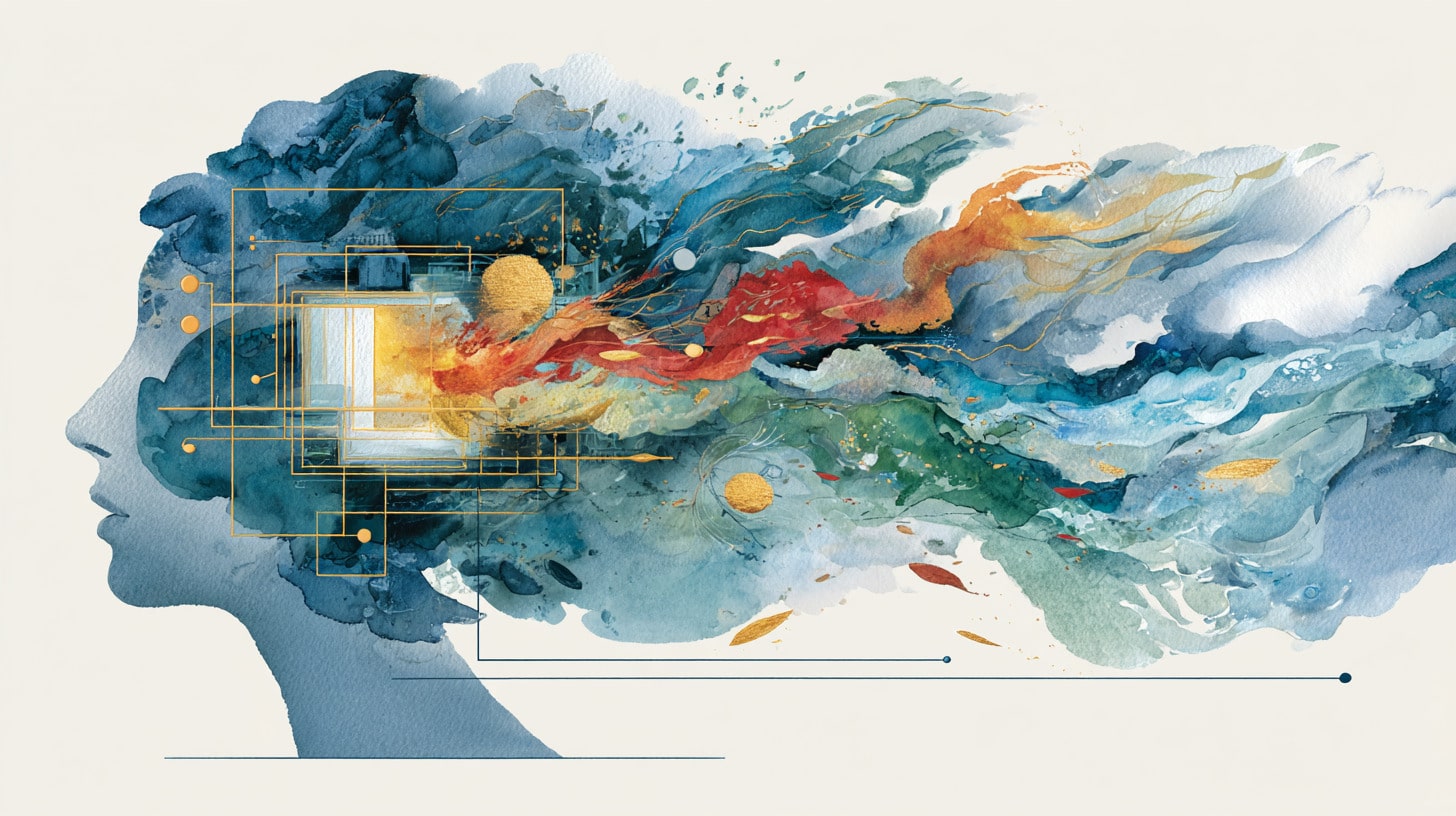

In the age of AI, imagination is one of the most important skills we need to grow. As generative AI and agentic systems begin to handle the bulk of our "output"—the writing, the coding, and the rendering—we are left with a deeper question of direction. To stay human and keep our agency, imagination is the key. It is the compass that tells the machine where to go.
In this blog, we are going to look at this skill technically, moving past the idea that it's just a "creative vibe" and treating it instead as a sophisticated internal system.
To understand how to build the future, we have to understand how the engine of imagination actually runs.
1. The Input Space
Imagination does not create something from nothing. Technically, it operates on the data we feed it. Think of this as your internal dataset. It is built from your sensory experiences, the facts you've learned, the stories you've heard, and the constraints of the world around you.
If you feed your mind shallow or repetitive data, your imagination will produce shallow results. To grow this skill, you must consciously expand your input space. The more varied your "knowledge primitives" are, the more raw material your mind has to work with.
2. The Representation Layer
Once the data is inside, your mind has to store it. But imagination doesn't store information in linear lists; it stores it in "concept graphs." This is where you turn specific details into broad abstractions.
A strong representation layer allows you to see the "pattern" of a bridge rather than just a single bridge made of stone. When you can turn concepts into symbols and mental images, you can move them around more easily. Great thinkers don't just have more ideas; they have richer ways of representing those ideas internally.
3. Transformation Operators
This is the core engine—the "functions" of the mind. This is what imagination actually does to the information you've stored. You can think of these as mental tools:
Combination: Taking two unrelated ideas and merging them into one.
Distortion: Taking an existing idea and exaggerating its size or importance.
Counterfactuals: Asking "What if this rule didn't exist?"
Temporal Shifts: Moving an idea from the past into a far-future setting.
By practicing these operators, you aren't just "waiting for an idea"; you are actively running a process to generate one.
4. The Constraint Engine
Imagination is often confused with daydreaming, but there is a technical difference: constraints. Useful imagination operates within a set of rules—whether they are physical laws, logical consistency, or ethical boundaries.
In an AI world, we use constraints to narrow down the infinite possibilities into something that actually works. A pilot's imagination is useful because it respects the constraints of gravity; a designer's imagination is useful because it respects the constraints of human psychology. Without the constraint engine, imagination drifts into fantasy and loses its agency.
5. The Evaluation Loop
Imagination is an iterative process, much like debugging code. Once a new idea is formed, your mind runs an internal simulation to see if it breaks. We look for "friction"—where the idea hits a wall or stops making sense.
This loop allows us to test a thousand futures in our heads before we spend a single dollar building one in reality. In the age of AI, our ability to evaluate and "feel" where a simulation fails is what keeps us in the driver's seat.
6. Output Artifacts
For imagination to be a skill, it must produce something tangible. These are the "artifacts" of your thinking: a hypothesis, a story, a prototype, or a new conceptual framework.
If an idea stays locked in your head, it hasn't finished the process. Externalizing the idea is what allows you to share it with others—or with an AI agent—to turn that thought into a reality. The quality of your output is a direct reflection of the health of your internal system.
7. Feedback and Updating
Finally, the system must learn. Every time an imagined idea meets the real world and fails, the system updates. This is training, not talent. By analyzing why an idea didn't work or by exposing yourself to a completely new domain, you "stretch" the system.
The goal is to move beyond your comfort zone until the "impossible" becomes just another input you know how to handle.
As AI continues to close the gap between an idea and its execution, the person who can imagine the most meaningful "what if" becomes the most valuable person in the room. We no longer need to compete with machines on speed or volume; we compete on vision.
Imagination is the only faculty we have that allows us to step outside of what is and decide what ought to be. It is the ultimate human agency. By treating it as a technical skill—one we can feed, train, and refine—we ensure that while the machines provide the power, we continue to provide the purpose.
Would you like me to design a few "imagination drills" based on these technical steps to help you practice?


