

Skip to content
Blogimagination
When the World Begins to Sing cover
9
Misagh Zad's avatarMisagh Zad

Listen: On Imagination, Storytelling, and the Art of Aliveness

0:000:00

On Imagination, Storytelling, and the Art of Aliveness

There are moments when something ordinary suddenly opens—a line of music, a glance between strangers, a sentence that lands—and for a breath, the world seems to sing.
It’s not loud. It’s recognition. It’s remembering something you didn’t know you’d forgotten. That instant—where imagination meets storytelling—is what meaning feels like.

This isn’t about music alone; it’s about aliveness—the current that runs through every true story, every act of empathy, every heart that chooses to listen.


The Imagination of Possibility

Imagination expands reality. It turns the bare facts of our days into something luminous.

  • Without imagination: a closed door.
  • With imagination: an unopened one.

That small shift from “nothing left” to “something waiting” is where meaningful stories begin:

  • It makes an artist pick up a brush.
  • A scientist question the obvious.
  • A tired soul believe there’s still music in the noise.

Imagination is the courage to believe the world isn’t finished—and that we can add a line.
This is where the Ministry of Meaning begins: the space between what is and what could be.


Stories as Bridges

Storytelling turns private experience into connection.

When a story is told well, we don’t just understand it—we enter it. For a few moments, another person’s world becomes our own. That is empathy in motion.

Stories remind us:

  • Pain can be shared without being solved.
  • Joy is contagious.
  • Grief can make us gentler.

Told honestly, a story not only connects us to others—it reconnects us to ourselves. We begin to see our lives as a composition—flawed, yes, but meaningful.


The Music Beneath the Noise

Beneath deadlines and notifications runs a quieter rhythm: the long line—the thread that connects each note (or moment) to the next.

  • Listening for that line is imagination.
  • Following it is faith.
  • Telling it aloud is storytelling—the art of making the invisible audible.

Leaning Toward Life

Live like music played from the edge of the bench—tilted forward, heart engaged.

  • Imagination refuses to stay neutral; it leans us forward.
  • Storytelling gives that motion direction: “Here’s where the music is headed—come with me.”

A meaningful life is motion—trusting the rhythm that pulls you toward wonder, even when it feels like falling.


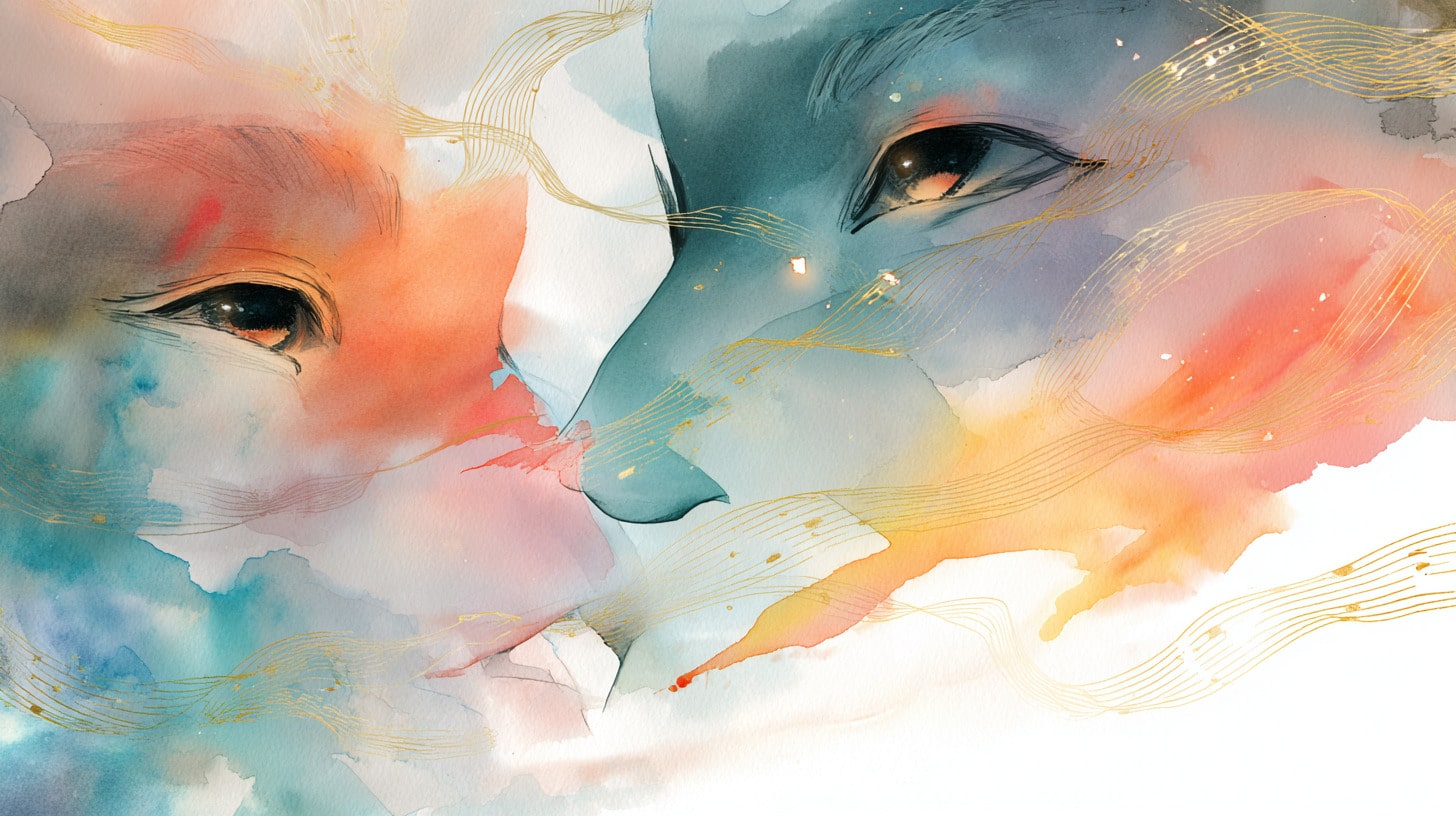
The Shining of Eyes

How do we measure a meaningful life? Not by certainty or control, but by shining eyes.

When eyes light up, imagination has jumped the gap between souls: you are not alone in this song.

Conductors of light are everywhere:

  • A teacher seeing potential in a restless child.
  • A friend who listens without interrupting.
  • A parent choosing wonder over worry.

Meaning spreads eye to eye, heart to heart, spark to spark.


The Art of Attention

At the core of imagination and storytelling lies one sacred skill: attention.

To imagine deeply, notice deeply:

  • The hand that trembles when someone lies.
  • The laughter just before it turns to tears.
  • The silence that says more than words.

Attention turns experience into understanding. In a distracted world, attention is rebellion—the refusal to drift past our own lives.


Imagination as Responsibility

Imagination has a moral dimension:

  • Imagine someone’s fear → you’re less likely to cause it.
  • Imagine their hope → you’re more likely to protect it.

Imagination makes cruelty impossible. Storytelling makes compassion inevitable. Together, they create the architecture of meaning as lived practice.


The Silence After

Every story ends in silence—but the after is different from the before.
It carries the resonance of what we’ve heard, felt, become. Meaning asks not for a perfect melody but an honest one.

Missed notes, improvisations, pauses—they belong. The beauty of the song is that it’s ours.


The Ministry of Meaning

Rather than a problem to be solved, life is a story to be told—and imagination is the language we tell it in.

Our task:

  • Awaken wonder.
  • Make eyes shine again.
  • Live and tell as if every word could be the last and every silence the start of a new song.

When we do, we join a quiet choir of storytellers, dreamers, and listeners keeping the long line of human meaning alive. And maybe that’s what the world needs now: a collective leaning forward—listening, noticing, imagining.

Because when we live like that—when our stories awaken rather than impress—something remarkable happens:

The world begins to sing back.

Picks for you

The Architecture of Imagination: Human Operating System

The Architecture of Imagination: Human Operating System

The Architecture of Imagination reframes imagination not as a vague creative instinct but as a structured internal system that gives humans agency in an AI-driven world. As machines increasingly handle execution, imagination becomes the human operating system that provides direction, deciding what is worth building in the first place. This system is shaped by the quality of inputs we absorb, how well we represent ideas as flexible patterns, the mental operations we use to transform them, the constraints that keep imagination grounded in reality, and the evaluation loops that test ideas before they meet the world. Imagination becomes powerful when it produces tangible artifacts and updates itself through feedback and failure. Treated this way, imagination is not talent or inspiration, but a trainable skill that allows humans to define purpose while machines supply speed and scale.

Read more
When the Future Speeds Up, Your Mind Must Slow Down

When the Future Speeds Up, Your Mind Must Slow Down

This essay argues that Kurzweil’s accelerating future makes ancient human skills more essential, not less. As AI grows faster than our intuition can track, the real risk is not technological power but a mind that cannot keep up with the meaning of it. Imagination becomes the first filter, the ability to choose which futures are worth building before machines help build them. Storytelling becomes the anchor, the way humans interpret overwhelming change instead of surrendering to fear or confusion. Critical thinking becomes the compass, the skill that protects us from manipulation, hype, and the fog of exponential progress. And empathy becomes the stabilizer, the one human capacity no machine can fully simulate, the glue that keeps intelligence from becoming isolation. Kurzweil maps the possibilities of the coming decades, but the essay argues that the real singularity is internal: AI amplifies whatever is already inside us. If our minds are clear, grounded, and intentional, AI becomes a creative ally. If not, it becomes an amplifier of noise. The Ministry of Meaning steps in here, to strengthen the human skills that shape the future rather than get swept away by it.

Read more
Forms, Not FOMO cover

A Practical Guide to Imagination Above the Line

This essay uses Plato’s Line to show how, in an age of AI-generated noise, our real power lies in disciplined imagination that climbs from illusion to tested understanding. Most of life now gets stuck in shadows and surface beliefs, while AI can either multiply those shadows or help us stress-test them, build models, and reach stable principles that guide real-world action. The path upward is practical: name the hype, touch reality through constraints and user stories, turn insights into simple models, anchor decisions in what does not change, and wrap it all in honest stories that move people. Imagination becomes most useful “above the line,” where wonder is paired with limits, empathy with precision, and critical thinking with small, testable bets. In this world, AI should act as our climbing rope, not our blindfold, helping us think clearly, feel deeply, and build things that actually hold up outside the feed.

Read more
Your Most Dangerous Skill cover

Your Most Dangerous Skill (And Why No One Told You About It)

This essay argues that writing is the most underestimated yet powerful skill because writing is thinking — it forces the slow, deliberate part of the mind to surface, clarify, and test ideas. Clear writing exposes vague logic, strengthens judgment, and builds trust, which is why people who write well consistently win decisions, resources, and influence. Through examples from Orwell, Forster, and practical workplace rituals, the essay shows that writing sharpens reasoning by demanding specificity, evidence, sequence, and self-challenge. Unlike the fast, reactive habits modern life rewards, writing trains precision, clarity, and honesty — the foundations of wise action. Master it, the essay concludes, and you gain a quiet but formidable form of power: the ability to think clearly, persuade calmly, and make choices that stand up to reality.

Read more
Reclaim Your Mind cover

The New Rules of Critical Thinking in the Age of AI

This essay argues that in an age where algorithms, media, and AI distort perception and flood us with competing narratives, the essential skill we must reclaim is a deeper, grounded form of critical thinking. Instead of reacting to the feed, we must learn to see through the layers of illusion, the emotional hooks, institutional narratives, and hidden incentives, and anchor ourselves to what remains true regardless of trends or noise. Through a simple protocol of naming the frame, tracing incentives, defining clear terms, questioning assumptions, testing opposing views, and staying rooted in unchanging realities, we rebuild sovereignty over our own mind. AI can amplify confusion, but it can also serve as a powerful tool for sharpening thought. The real revolution, the essay concludes, is reclaiming clarity in a world built to hijack it, responding instead of reacting, and standing on internal truth rather than external noise.

Read more
The Discipline of Wonder cover

Why Imagination Is the Skill That Outlasts AI

This essay argues that imagination is becoming the most essential human skill in an age obsessed with efficiency, because wonder, not optimization, is what expands our inner world and fuels creativity. Modern life trains us to fill every silence and rush past small moments, but awe lives inside pauses: the unhurried walk, the sunset, the child studying a worm. These micro-wonders activate the brain’s deeper creative networks, restore our humanity, and protect us from outsourcing curiosity to AI, which can only remix what already exists. By practicing daily wonder — noticing, slowing down, letting surprise land, we reclaim the imaginative capacity that machines cannot replicate, and resist becoming efficient but hollow versions of ourselves.

Read more

Comments

Sign in to join the discussion.
Loading…