
Should the U.S. Acquire Control of Greenland?
In recent years, U.S. President Donald Trump has argued that the United States should acquire Greenland—a semi-autonomous territory of Denmark—for national security and strategic advantages in the Arctic. Proponents highlight geopolitical threats and resource access, while opponents cite sovereignty, international law, and diplomatic risks. This debate asks whether U.S. acquisition of Greenland would be justified or problematic.
AGAINST

Sovereignty, International Law, and Diplomatic Risks
FOR

National Security and Strategic Advantages in the Arctic
Written Arguments
Core Claim
Annexation or pressure tactics risk repeating colonialist dynamics, harming indigenous rights and cultural preservation, and could provoke regional instability.
Core Claim
Forcing or acquiring another nation's territory undermines modern norms of self-determination and could be illegal under international law.
Core Claim
Both Greenland's autonomous leadership and Denmark reject the idea of selling or ceding control, insisting their future should be decided by Greenland's people.
Core Claim
Attempting to acquire the territory could fracture alliances with Denmark and other NATO partners who view it as an infringement on a fellow member's territory.
Core Claim
Developing infrastructure, extracting resources, harsh Arctic conditions and social programs would require massive investment with uncertain returns—possibly outweighing strategic benefits.
Written Arguments
Core Claim
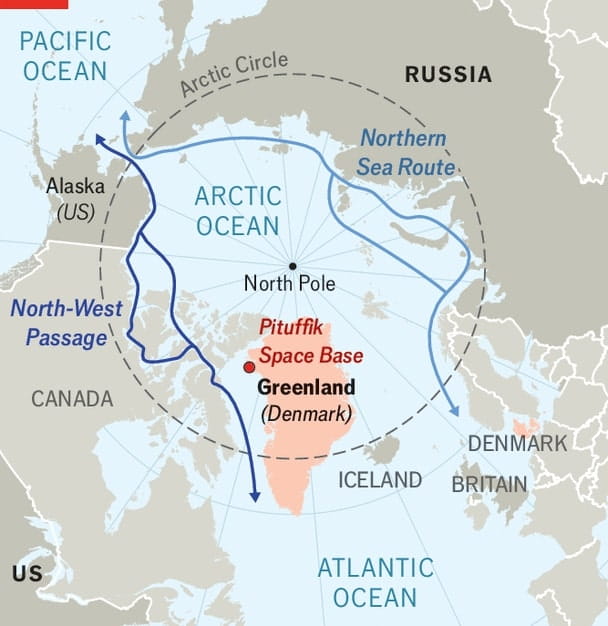
Greenland sits at a key geographic crossroads in the Arctic, allowing the U.S. to better monitor missile paths and northern approaches into North America, strengthening early-warning defense systems.
Core Claim
With Russia and China increasing their Arctic activities, U.S. control could preempt potential military or economic influence by strategic competitors.
Core Claim
Greenland's untapped rare earth minerals, uranium and other resources are valuable for defense and green technologies—securing them could reduce strategic dependencies on foreign suppliers.
Core Claim
Melting ice is opening new northern sea lanes. U.S. control could improve its ability to regulate these emerging strategic shipping routes.
Core Claim
The U.S. has had military and strategic interests in Greenland for decades (e.g., air base and defense cooperation), so formal territorial control might align these long-term commitments into a coherent policy.